The Lindfield Brewery
By John Mills, Lindfield History Project Group
In Lindfield High Street in 1914, there were five public houses, the Bent Arms, the Red Lion, The Stand Up Inn, the Tiger Inn and the White Horse, all selling beer obtained from commercial breweries, mostly in Brighton and Lewes. But one hundred years earlier, the village’s pubs were either brewing their own beer or being supplied by The Lindfield Brewery.
Beer was produced from barley, sugar, hops, yeast and water (known as “liquor” in the industry). The barley was made into malt in a malthouse, by soaking it, allowing the seeds to sprout, and then drying it in a kiln to stop the sprouting. The malt, once ground, was mixed with hot water to convert the starch to sugar, and the now sweet liquid (the “wort”) was boiled with dried hops, cooled, and passed into a fermenting vessel. Yeast was added, which feeding on the sugar as fermentation proceeded, converted the sugar to alcohol. After a few days excess yeast was removed and the resulting beer left to mature before being put into casks or bottles.
In the 1700s, Lindfield had a malthouse, where the Congregational chapel now stands, and at one time a hop kiln, much later replaced by the house at 78 High Street. Some houses had brewhouses (or brewing rooms), for home brewing from malt, but most brewing in Lindfield village would have been carried on in outbuildings of its inns.
Wholesale commercial brewing arrived in Lindfield after 1784, when a Brighton brewer, Richard Lemmon Whichelo, bought Malling Priory, a private house. On part of its large garden, between the Bent Arms and the back of the house, he erected brewery buildings around three sides of a yard. The distinctive half-H-shaped configuration of the buildings appears on a map of 1792. Later, only part of Malling Priory was used by the brewery, the remainder let to other tenants. In the early 1800s it was known as the Brew House.
Whichelo’s main residence and brewery remained in Brighton. From 1800, he first tried to sell, then let his Lindfield brewery, with two pubs attached; he also owned the White Lion (now Bent Arms) and Ryecroft (52 High Street), the first site of the Red Lion.
In 1801 the brewery was advertised as the only one within 12 miles of the village, “with a new-erected Malt-house, convenient store-rooms, vault, stabling (and) large yard…..The business of the Brewery is done with little expence; the work being done by a horse mill, where the malt is ground, the liquor is pumped up, and the worts into the copper (boiling vessel), all at one time.” In this mill, or “horse gin (engine),” a horse walked in a circle, pulling a timber arm linked to gearing which operated the pumps and grindstones.
Henry Clerk, brewer, rented the brewery in 1803, in 1806 selling the remainder of his lease and the contents of the house and buildings, including “Old Beer, Porter, malt, hops, vats and casks, two draught horses”.
Hughes and Co., partners in the Storrington Brewery, were the new tenants, and ran both breweries until 1815, when they went bankrupt. An Eastbourne coal merchant and brewer, Richard Buckley Stone, who lived for a time in Lindfield, became tenant from 1815, using the brewery also for his coal business. Before 1819 he also went bankrupt.
Whichelo, still the owner, died in 1818, leaving the White Lion and brewery to his son Matthew, a wine merchant. He promptly but unsuccessfully put them on the market, then let them in 1819, advertising that “There are a great number of free Public Houses in the neighbourhood of Lindfield, with which considerable (brewery) business has been done.”
A new partnership, (William) Durrant and (Thomas) Wileman, then rented the brewery, both local men, “common- (commercial wholesale) brewers and maltsters”. In 1824 -1827 John Bent, Gentleman, bought several houses in Lindfield, the brewery and the White Lion, changing the pub’s name to the Bent Arms.
Wileman and another partner had left the partnership by 1825. William Durrant, who also had a High Street grocer’s and draper’s (cloth) shop where the Co-op now stands, continued the brewery on his own. During his occupancy part of the Brew House was let to his niece Miss Ann Baker, for her boarding school for young ladies.
In 1833-34, William Durrant too went bankrupt, having to sell his properties, but kept the tenancy of his shop. Bent let the brewery to Gosling Philp and Richard Philp, common-brewers and partners, but when the first dropped out and the second was bankrupted in 1838, the brewery was again left untenanted.
From 1839 Henry Adolphus Baber briefly rented the brewery, he and all subsequent tenants until 1885 describing themselves as maltsters, rather than brewers. Apparently, brewing at the “Old Brewery” had ended.
Baber was also a corn and coal merchant; the buildings and yard continued for coal merchant’s stores, and presumably the malthouse for malting. The Bent family properties were put up for sale in 1885, and the brewery demolished in 1886, to be replaced in 1890 by the present semi-detached houses, 92-94 High Street.
William Durrant may have seen a gap in the local brewing market appearing around 1839-40, buying a house and butcher’s shop (known as “Morlands”) at 53-55 High Street (Eye Care Practice and Mansell McTaggart). In 1840-41 he again described himself as a brewer, together with his son Edward, and by 1842 had built behind Morlands a small brick-built brewery (now converted into two cottages, Old Brewery and Old Brewery Cottage, 49-51 High Street). Morlands became William Durrant’s new grocer’s and linen draper’s shop.
William died in 1848. In 1845, Edward Durrant was running the “new” Lindfield Brewery and did so until the end of his life (1902). After the redevelopment in 1854 of the corner of Denman’s Lane with five terraced houses (41-47 High Street), Edward leased the northernmost house and opened it as the Brewery Tap beershop, under William Barlow, also a boot and shoe maker. The beershop proprietor was licensed to sell beer and cider only, for consumption on or off the premises.
The ground floor premises of the early beershop were small (they now occupy three of the five houses in the terrace). The story goes that Edward Durrant considered that if workmen had a glass of beer standing up, they returned to work, but if they sat down over it there was no knowing when they would return; and so the beerhouse, without chairs, became known as “The Stand Up Inn”.
In 1879 the brewery offered a “Family Bitter Ale” for one shilling (1s/ 5p) per gallon (8 pints), and in the 1880s “home-brewed ale from eightpence (8d/ 3½p) to 1s 6d per gallon, a “Light Dinner Ale” and “London porter, stout and double stout”. Later, prices were 2d to 8d a quart (two pints), the cheaper beer being known familiarly as “apron washings” (slang for porter).
Behind Morlands, where the Durrant family continued their grocery shop until the 1970s, there was another horse gin under an octagonal roof, which was used for the brewery’s pumping and machinery.
When Edward Durrant died, the Lindfield Brewery carried on under his widow and son, Fanny Sara and Bartley Durrant, until 1906, when it closed. Her name, and “Licensed Brewer”, can still be seen on a timber beam in The Stand-Up. In 1909 Ballard & Co., of the Southover Brewery, Lewes, bought the brewery, but besides supplying the beerhouse with their 1910 Premier Ale and Coronation Ale, did not re-start brewing there.
After being damaged in the 1987 great storm, the horse gin eventually collapsed, but thanks to the Durrant family and by dint of strong co-operative local efforts, the gin was re-erected behind the Red Lion in 1995.
THE CHANGING HIGH STREET – Part 1
By John Mills and Richard Bryant
How much has the High Street, which runs from the Black Hill mini roundabout northwards to the top of Town Hill, just beyond All Saints Church, changed in 100 years? This article compares the High Street in 1923 with today.
Starting on the western side of the street, the section from Black Hill roundabout along to the Pond, is little changed. The exception being Pondcroft, on the corner of Pondcroft Road, had at the front an ironmonger’s and office of Anscombe and Sons. Their builder’s yard and workshop, now a private house, was a short distance up Pondcroft Road. The houses around the Pond are unchanged.
The section from the northern end of the Pond to Denmans Lane has seen the most dramatic change. Whilst the townscape of the High Street has remained largely visually unchanged and immediately identifiable. This area has changed beyond recognition with No 31 not being built until 1924. All the original buildings were demolished in 1964 and eventually replaced by the shops seen today, Selbys, Co-op and Nova Medispa. In 1923, this area was the site of Masters Grocery and drapers shop regarded locally as Lindfield’s ‘departmental store’ and next door was Downs House, the Masters family home.
Across Denmans Lane, the corner premises today, Corner Hairdressing was Wood’s Cycle Store. Next door a Confectioners and Tobacconist shop, was run by George Mighall; today soon to be the Black Duck coffee shop. Previously the neighbouring business was Capital and Counties Bank that had opened a branch in 1910. The bank became part of Lloyds Bank in 1918 and the branch remained open until 2000. The premises were then acquired by Stand Up Inn becoming part of the inn. When occupied by the bank, Mary Newton, lived and had a dressmaker’s business on the premises.
Standing back from the pavement, The Old Brewery and Brewery Cottage, Nos 49 and 51, were once part of Lindfield Brewery that stopped brewing in 1906 and was subsequently used for storage in 1923.
The fine medieval building, today Lindfield Eye Care Practice and Mansell McTaggart, was in 1923 the long-standing location of Durrant’s grocers, china and drapers emporium. Nos 55-57 High Street, Lindfield Medical Centre, was the site of the former Assembly Rooms but used in 1923 as storage by Durrant’s shop.
Adjacent to the walkway was Miss Simmons, stationer and newsagent, now Tufnells Home. Mounted at first floor level and difficult to see on the neighbouring building is a nameplate reading Prospect House, the home of Hamilton Stone Design, kitchen designers and installer. A hundred years ago it was the popular shoe and boot shop run by Joseph Pranklin.
The adjacent private house was the home of Richard Humphrey, who with his father ran the eponymous Humphrey’s bakery. In recent years it was Lindfield’s best known shop, having been a bakers since 1796. Sadly, it closed a couple of years ago and awaits a new purpose. Behind stood the bake house now repurposed as the soon to be new home of Doodie Stark, a ladies fashionable boutique
In the mid 1800s, a short terrace of three storey properties was built called 1 – 4 Victoria Terrace now formally numbered 67 – 73 High Street. First today is the Limes Thai Kitchen, until the late 1920s it was a private residence and then it became the Lindfield Telephone Exchange, following the electrification of the High Street. Alongside was the home and business of T W Heasman, a house, land and insurance agent. Today, it is Caragon and Kell & Collins, ladies’ clothes together with the latter’s interiors and gift shop. Wilfred Capon’s ladies’ and gentleman’s outfitters and general drapery shop traded next door, today the home and business premises of Peter Voigt, a violin restorer. Just as it was in 1923, No 4 remains a private residence.
Known as ‘Poplars’, Nos 75 and 77 High street are today Tufnells, and Denziloe Hair Design was Joseph Whall’s hairdresser and Poplars Laundry run by Miss May Brown. Kieron James Toys next door was an annex to the laundry.
In 1923 Wigelsworth Tailors had a branch under the management of George Blunt in the premises now occupied by Martins Newsagents and Lindfield Post Office. Pleasingly, Abbott’s name has remained unchanged serving as a chemists for Lindfield for well over a century, although the owners have changed. The outbuilding in the backyard was Rainbow Pottery.
The fine dwellings, Manor House and Nash House, have always been residential and whilst the adjoining timber framed Well House and Barnlands give a similar impression. They had previously been a poulterers and greengrocers shop. Maud Savill of Finches with her desire to beautify the High Street purchased the property and converted the shop and cottages into the two houses as seen today.
On the northern side of Hickmans Lane, stands a retail unit that, in many years past, was a Toll Cottage for the Newchapel to Brighton Turnpike Road. In 1923 it housed the business of Clifford Featherstone, a watch and clock maker. Until recently the home to Doodie Stark, and the last retail unit before the street becomes wholly residential. This was not the case a century ago.
Adjoining was Wratten’s grocers and drapers shop; evidence of this past retail use can be seen by the blank plaque on the facade below the roof line, which once carried the shop’s name. At Doone House, No 111, David Davies ran a tailoring business and his wife, Helen a costumier’s. In the yard at No 115 was the coal and wood merchants owned by James Scutt, the family lived in the house. A little further up the street lived the Misses Wells who were milliners.
Evidence of past trade use can also be seen on the southern side wall of No 129, the now painted over trade sign read, ‘George Mason Fly and Cab Proprietor. Carriages of Every Description For Hire.’ While in the right section of the property, Romany Cottage, a shop window still remains in the northern front corner. This part was occupied by Joseph ‘Daddy’ Clough, a boot and shoe maker.
The Bower House, built in medieval times and widely regarded as one of the three oldest surviving houses in Lindfield, surprisingly was in 1923 divided into two cottages. The southern end was home to John Wingham, a builder, and his family. The other half was the home of Herbert Scutt and family, his occupation was motor carman; a carrier of goods by motor van.
Beyond this point has always been residential with Lindfield Place providing the full stop to the High Street. This ends the journey up the western side of the High Street. Next month’s article will return down the east side.
THE CHANGING HIGH STREET – Part 2
The previous article compared the west side of the High Street in 1923 with 2023, in this article we journey down the eastern side. Starting at the top of the High Street from the ornate Lindfield sign down to All Saints church is today residential as it was in 1923. After the Church, the Tiger had ceased being an Inn in 1916 becoming the Parish Church House and has continued to be ever since.
After the passageway, 1 Tiger Cottages, No 120, was a sweet shop called The Little Shop. Evidence of this past use can be seen in the remains of a shop front. After these cottages, Tallow Cottage built in 1975 is the newest house in the High Street. It stands on the site of a wide entrance to the backyard and slaughterhouse of Wickham’s butcher’s shop and family home, which was situated in Oakley House, No 112. From this point down to the corner of Brushes Lane today is all residential. The exception in 1923 being Spongs, on the corner which was Alfred Carey’s house and had his ironmonger’s shop attached. The large shop window is still evident, as is the old forge to the rear.
Brushes Lane until 1957 was little more than a bridleway when it was widened to provide access to the Dukes Road development. This necessitated the demolition of a building known as The Cot that had been built in the 1860s adjacent to the Bent Arms. Over the years it had had many uses from railway company offices to storage to a dwelling and even, it is said, the Musical and Literacy Institute.
To the rear of the Bent Arms is No 96 High Street. Previously the coach house and stables of the inn it is now in mixed use. Today beyond this point down to Boarsland on the corner of Alma Road is all residential. This was not the case a hundred years ago. Priory Cottage, No 86, originally a medieval hall house, Crosskeys, No 76, and Boarsland, No 72, all had shop extension build-outs in their front gardens out to the pavement. Priory Cottage was a stationers and newspaper shop run by Ernest Welfare. Crosskeys, 76 High Street, also dating from medieval times, was divided into two cottages with the southern part having the front extension which was the fishmongers and poulterers shop of Jacob Driver. Boarsland was Thomas Charman’s bakers shop with the bake house behind.
Crossing over Alma Road, South Down Cellars wine merchants was in 1923 H P Martins corn and coal merchant. A short mid Victorian terrace known as Albert Terrace follows, today containing Ounce, Jackson-Stops, Somers café and Mathilda Rose. Respectively these were Mrs Helen Hodson’s confectioners, Rice Brothers’ saddlery and harness makers, Herbert Caffyn’s tobacconist and confectioners and finally at 1 Albert Terrace, John Holman’s Cycle and Motor Cycle Depot; until December 1922 it had been a cycle and gramophone shop.
Below the Red Lion, stands Porters a residential property previously Dr Hay’s surgery and family home. The private housing continues down to the United Reformed Church, originally the Congregational Chapel.
The next area was devoted to the Box family businesses. They ran a nursery that stretched parallel with Lewes Road and up Luxford Road. Interestingly, one of only a few shop to have continued the same trade over the period is Paul’s greengrocery. This had been James Box’s greengrocer shop. Next door was their florists, today Mark Revill & Co. Again continuing the same trade is Cottenham’s that was the Box butcher’s shop. Behind was Box’s storage and preparation rooms, today occupied by Six Physio.
In competition with Lloyds Bank across the road, Barclays had a sub branch in the first cottage, No 38. The neighbouring cottage was the home of John Sharman, Assistant Clerk to the Parish Council. This was followed by the Post Office and its adjoining sorting room, later extended into the Post Office, now Truffles Bakery.
Crossing Lewes Road and after Pear Tree House and King Edward Hall in 1923 and until recent times was the White Horse Inn, now converted into the Tamasha Indian Restaurant. Slake Coffee Shop is housed in the inn’s stables. The private house, No 18, did not exist in 1923 as this was the site of Lindfield Motor Garage owned by Messrs Boggis & Franklin. At Nos 14 &16, the front shop extension, today the home of the Lindfield Barbers was a hundred years ago a fishmongers and fish and chip shop run by Hubert Ellis. In later years it became the Pond Shop. Beyond this point the High Street remains residential with the last property on the east side being Pelham House.
The big question is how does the High Street today compare with 1923? The answer in a few words is very favourably, with both serving the needs, trends and their communities of the time. There were a few more shops a hundred years ago but several in the same trade and presumably in competition. Missing today are drapers and ironmongers but this a national trend. That said, it is probably fair to say, today’s shops collectively have a far greater range of goods than their earlier counterparts. Lindfield is fortunate to have such a vibrant High Street and long may this continue.
WILLIAM MARCHANT – THE LINDFIELD PHOTOGRAPHER
If you or a family member have lived in Lindfield for many years, it would not be surprising if tucked away at the bottom of a drawer, or in an old album, there is a photograph by William Marchant. His photographs have provided a rich legacy of life, events and people in Lindfield during the first half of the last century. They are recognisable by his signature or embossed name.
William Marchant was a commercial and press photographer and it could be said that if it happened in Lindfield he would photograph it; any topic that had potential for sales was his bread and butter. His formats ranged from mounted photographs, hand coloured photos for framing to postcards. Many of his images were produced as cards, being an inexpensive keepsake and widely used to send short messages by post. Postcards were the equivalent of mobile phone photos and texts today.
His work included studio portraiture, composed outdoor photographs and events. Generally, only limited numbers of scenic postcards were produced.
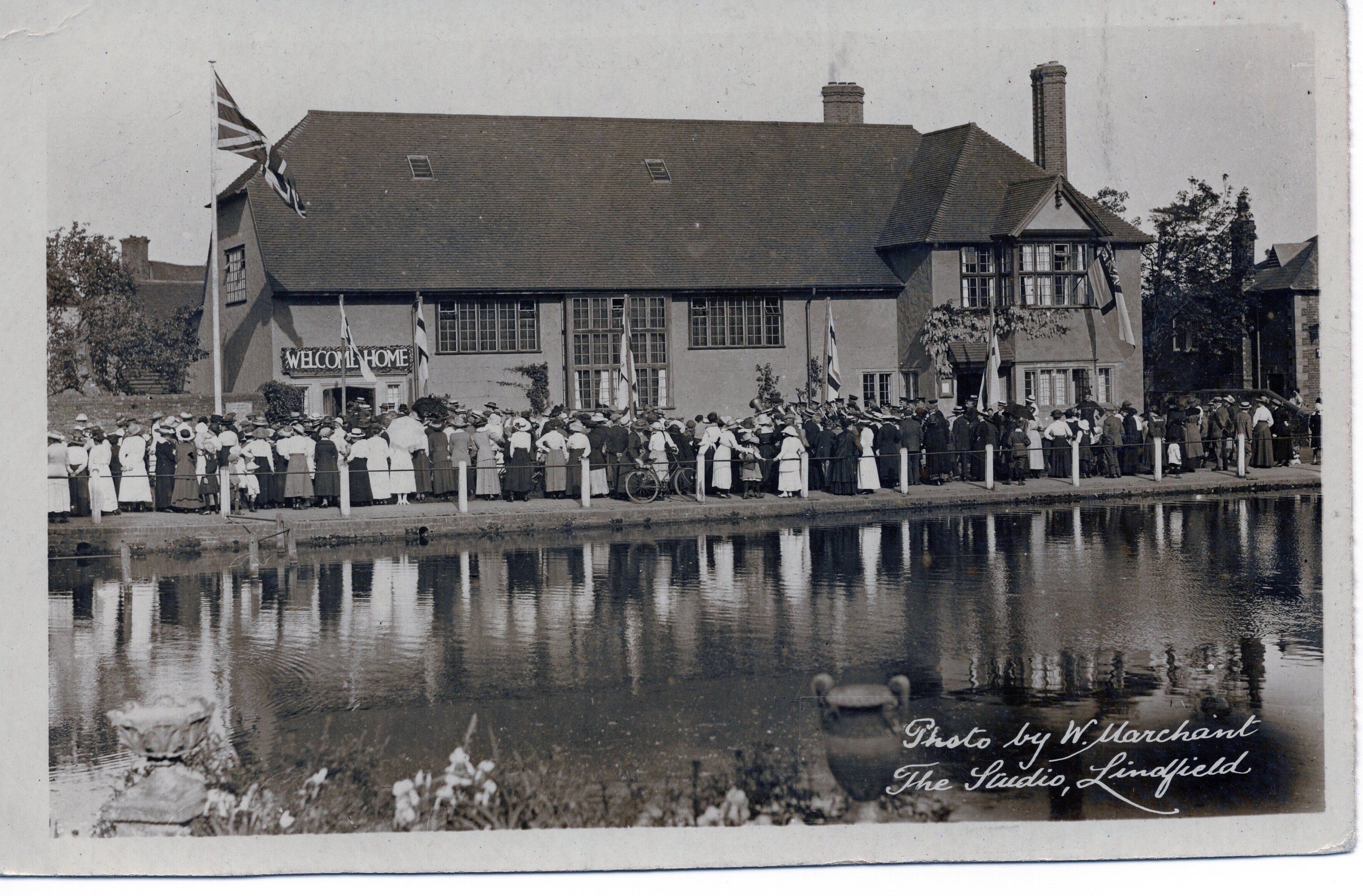
William Marchant started his business in 1911 and among his earliest work was a series of cards capturing the village celebrating the 1911 Coronation. He advertised in the Mid Sussex Times ‘have your decorations, your house, garden etc. photographed, for post cards on Coronation Day’. Perhaps his best known photo is his impressive image of the Army airship ‘Gamma’, which landed on the Common while on a training exercise in April 1912. Fifteen hundred photographs were sold with cards at one penny each and mounted photographs at one shilling. The Great War provided a rich source for him, with postcards from the Royal Army Medical Corps billeted in the village to the Welcome Home celebrations and the unveiling of the War Memorial.
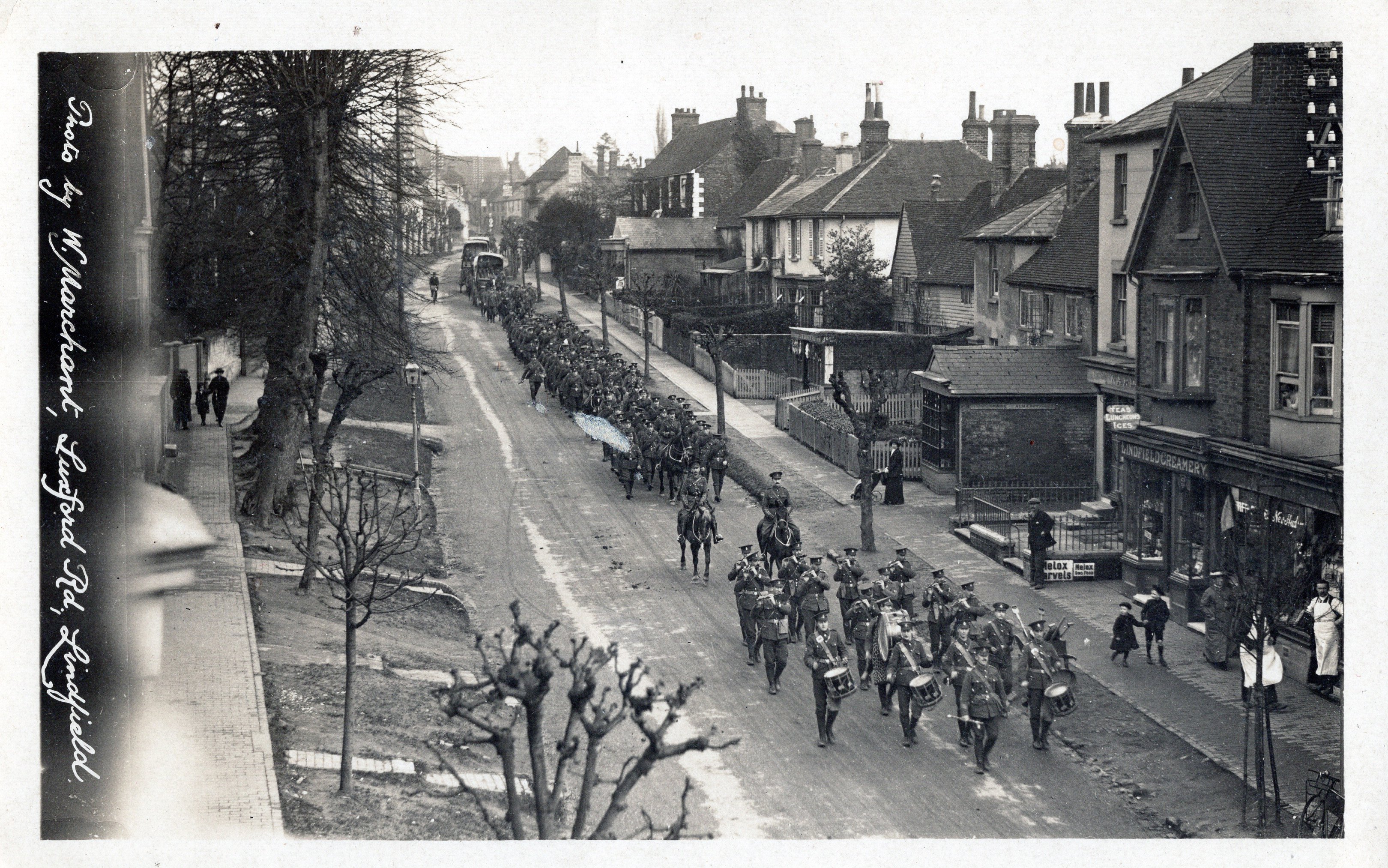
As his career progressed, the quality of his work was recognised with Marchant’s appointment as the Scientific Photographer to Sir Arthur Woodward the eminent geologist who was famously fooled by the Piltdown Man ‘missing link’ fraud. William Marchant could also claim that he took one of the first photographs to appear in the Mid-Sussex Times; that of Mrs Neville Chamberlain opening a hospital ward at Cuckfield.’
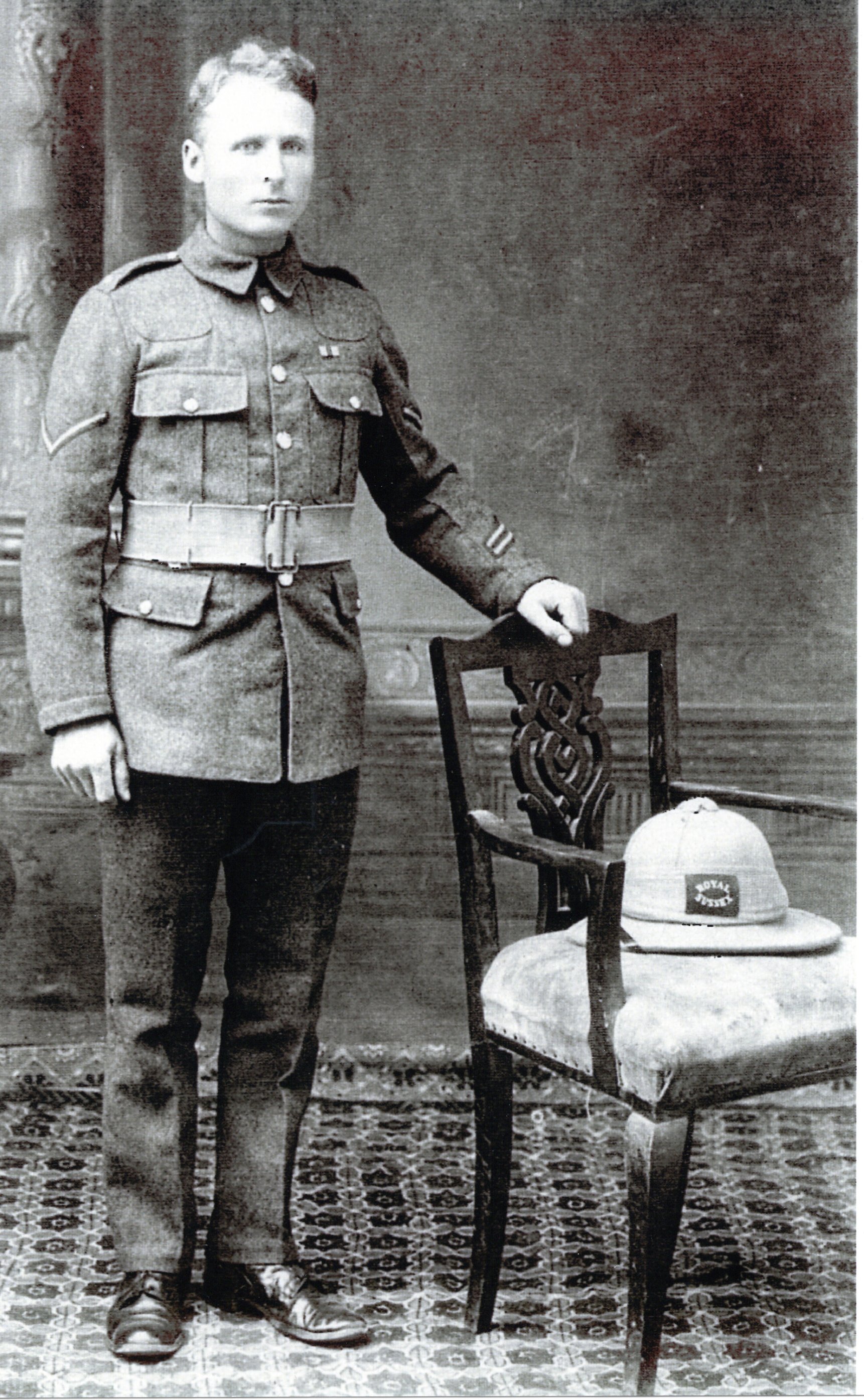
The opening of his studio at 6 Luxford Road (old numbering) allowed portraiture of individuals and families. This line of work took off with the Great War, when every family and sweetheart wanted a picture of their ‘man in uniform’ before he left Lindfield for an uncertain future. Family celebrations, weddings, gatherings were also much in demand throughout his career. Also popular were photographs of cast members in productions at King Edward Hall, sports teams and posed outdoor subjects.
His later works included photos for the Haywards Heath, Cuckfield and Lindfield Guide published by the local Chamber of Commerce and the All Saints Church Guide, written by Helena Hall.
Who was William Marchant? He was born on 21st August 1886 to his parents John and Elizabeth Marchant, who lived at Somerset Cottages adjacent to the Common. William was one of six children. After leaving school he trained and worked as a printer at Charles Clarke Ltd. William Marchant married Myra Hookway, a Lady’s Maid for the Sturdy family at Paxhill, in August 1912 at Lindfield Parish Church and they set up home at 6 Luxford Road, where he opened his first studio. He continued living at Luxford Road until moving to Sunte Avenue, in 1924, where he built a studio and small printing works in the rear garden. William Marchant worked until late in his life, dying aged 79 years in 1965.
LINDFIELDS ONLY VICTORIAN FACTORY
Lindfield being a rural parish escaped the changes brought about by the industrial revolution, although one factory was built early in the Victorian era. It stood where Lindfield Medical Centre stands today.
In 1840, Thomas Durrant a wood turner, from a prominent Lindfield non-conformist family set up a piano business. He soon established the Sussex Pianoforte Manufactory in a workshop next to his home, Broomfields, (54) High Street. His first employee, Alfred Steibler, a piano maker, came from London to make pianos.
The Victorian values of hearth and home with a family’s entertainment centred on music making, created considerable demand for pianos. His business quickly expanded and by 1851 he was turning out ‘cottage pianofortes’ and other types at a rate of 100 per year. Some were transported to London and Brighton for auction with the ‘commendation of several first-rate professional men and dealers in England and Scotland’. To expand the thriving business and accommodate a growing workforce, Thomas Durrant needed much larger premises.
Around 1852, he bought Milwards, an old freehold property, opposite on the western side of the High Street. Shortly after, Durrant demolished the old property and in its large back garden in 1854 built a new factory with a wide gated entrance and an extensive forecourt. Unusually for Lindfield, it was a three storey building with a high roof and large windows necessary for good lighting. Within 10 years he contracted P Jupp to install gas lighting: the gas being supplied by the Lindfield Gas Works, situated at today’s Chaloner Close. The factory was described as a ‘modern, well-lighted and heated, clean, spacious building, specially built for the purpose for which it was used’. Pianos were made on a ‘production line’ with each man performing a specific task. Alfred Steibler was said to be the only Durrant employee who could make and construct an entire piano.
Anecdotally, it has been said villagers nicknamed this fine establishment ‘The Piggery’ because the workers were dubbed ‘the pigs’ on account of drinking so much beer at the end of the week in the Stand Up Inn.
In addition to making and carrying a stock of new pianos for sale at the factory, the business also proudly advertised its Repairing and Regulating Department, ‘where every care is bestowed’ and a tuning service.
In 1860, the factory employed over 30 men and during the next two decades established sales branches in London and Birmingham. By the 1880s, British piano making was in decline due to imported pianos made in Germany having taken a large share of the market. The decision was taken in 1881 to close the manufacturing department. Thomas Durrant retired in early 1882, selling surplus stock and other items, handing the business to his son, Richard Durrant. Consequently the name was changed from Sussex Pianoforte Manufactory to R Durrant Piano Warehouse, advertising piano, harmonium, American organs tuned and repaired, in addition to sales and hire.
As the nature of the business had changed there was no need for such a wide gated entrance to the forecourt. This was narrowed, to the current width of the walkway, to the Medical Centre and car park, by building two houses with shops, today Tufnells Home and Kitchens by Hamilton Stone Design.
The Piano Warehouse under Richard Durrant’s management continued to be advertised in local directories until 1887, when he relocated his pianoforte business to Rugby. He remained in business until his retirement in 1924.
Piano production having ceased less space in the building was required, as the Pianoforte Warehouse occupied only part of the ground floor thus freeing up the remainder of the premises. The Durrants rented the spare space to George Eastwood, who engaged a Lindfield builder, Charles Andrews, to convert the space into the New Assembly Rooms. The Assembly Room was on the first floor with a Mission Room below. Lindfield was in need of a larger entertainment and meeting venue as the only function rooms, at that time, were at the Bent Hotel and the Reading Room in Lewes Road.
The Mid Sussex Times reported at considerable length the opening of the New Assembly Rooms on 15 May 1883. The rooms were complimented for being light, airy, very neat and tastefully presented. There were ‘16 windows, letting light on the subjects, whilst from the ceiling there are two handsome gas pendants. There is a balcony at the entrance end and a stage at the other, and seating arrangements for about 220.’ A grand curving staircase led from the ground floor entrance. The Rooms were regarded as providing a ‘valuable acquisition to the town.’
The New Assembly Rooms were managed by a ‘committee of gentlemen’ with George Eastwood as the Secretary and Josiah Durrant as Acting Agent and Booking Manager.
Until the opening of the King Edward Hall in 1911, the New Assembly Rooms were the centre of social life in Lindfield with regular events ranging from Music Society Concerts to Harp Recitals, from Captain Acklom’s Elocutionary Entertainment to Chrysanthemum Exhibitions, and Christmas Entertainment for Children to Lindfield Board School’s Prize Distribution and Scholars Entertainment. Perhaps its most noted event was in 1884 when Oscar Wilde delivered a lecture on ‘The Value of Art in Modern Life’.
In contrast to the entertainments upstairs, the Mission Room was the centre for the local temperance movement by the Church of England and Gospel Temperance Union promoting alcohol abstinence. Meetings and lectures were held weekly and a lending library was provided, also occasional appropriate entertainments including ‘Mr & Mrs Brown and Miss Skelton the Singing Negro Evangelists’ and an ‘appearance by Wah-Bun-Ah-Kee (Red Indian)’; he was quite famous.
Following the relocation of the Pianoforte Warehouse, the New Assembly Rooms were enlarged. Some of the ground floor space was taken by Edward Durrant as a showroom and store for his High Street shop; and was described in December 1888 as providing ‘baskets, aprons, wraps, cushions, pottery and lace goods’.
The opening of King Edward Hall and the Great War signalled the final decline of the New Assembly Rooms building. Reputedly it was used as a rabbit farm to assist with food shortages during the war. During the 1920s and 1930s it was used for furniture storage and became derelict, but was requisitioned by the military in World War 2 for an unknown use.
In the early 1950s, the building was brought back to life, returning to its manufacturing roots when Herbert and Paul Christian trading as O H Christian Ltd used the premises for their clothing manufacturing business. They specialised in making good quality skirts for leading brands, hence locally being known as the Skirt Factory. On the first floor was the fabric store with Paul Christian making the patterns and doing all the cutting. Downstairs was the machinist’s area with many Singer sewing machines and the finishing and pressing department. The factory employed around 20 local women, who enjoyed the perk of ‘overs’ being sold cheaply.
At the beginning of the 1970s, O H Christian Ltd went into receivership and the property became empty again. Shortly after the building was demolished making way in 1974 for Lindfield Medical Centre and Toll Gate car park.
THE RAINBOW POTTERY COMPANY
In late 1921, an enterprising woman, Gladys Van Weede established, as sole proprietor, The Rainbow Pottery Company trading from an outbuilding behind Abbotts Pharmacy in the High Street. Born at Worthing in 1888, she married Rollo Van Weede in 1915. They lived at Pascotts Farm, Sluts Lane where he ran a dairy farm. According to the 1921 Census, prior to founding Rainbow Pottery, Gladys Van Weede worked as an artist for Margaret and Christine Warneford, both artists, at 13 Mill Green Road, Haywards Heath.
Within months the business was flourishing and commercial travellers secured sales across the country. In April 1923, the Lindfield Women’s Institute held an exhibition of Rainbow Pottery products at the King Edward Hall. Intriguingly the Mid Sussex Times reported ‘that members of the Institute are responsible for the work. What the ladies really do is to hand colour, by a secret process, Staffordshire Pottery, and the artistic blending of colours on powder bowls, vases and other articles on exhibition was delightful’. It further commented, ‘The fact that any colours can be blended onto any articles of pottery and glass suggests infinite possibilities’.
On 28th November 1923, the Company held another exhibition at the King Edward Hall of their ‘Novel Hand-Coloured Pottery, Glass-Ware, Trays, and Tables etc.’ Mrs. Van Weede was assisted at the exhibition by a number of ladies from the upper echelon of Lindfield’s social scene. The hall was decorated with plants and cut flowers and to make the exhibition a social and charitable event afternoon tea was served and a musical programme performed by local musicians. Fifteen per cent of Rainbow Pottery sales and a share of other proceeds were divided between the Haywards Heath Hospital and the Lindfield Nursing Association.
In 1924, Rainbow Pottery took a major step forward, securing a stand in the palace of Industry Pottery and Glass Section, at the prestigious British Empire Exhibition at Wembley. It was quite remarkable that a small three year old company trading from an outbuilding behind the High Street exhibited at such an event.
As well as their hand decorated products, the company also sold, both retail and wholesale, the Danesby Ware Electric Blue pottery range manufactured by the well-known Denby Pottery Company.
The Rainbow Pottery Company was acquired by Mr. J.N. Carter, who is understood to have also run the Lindfield Steam Laundry. The date the business changed hands is not known. The Company continued selling various pottery items, miniature china animals and also glass and chrome items, such as honey glass table condiment sets, serviette rings and cake stands. They were advertised as being of ‘Special Attraction for Bazaars, Fetes, sales of works, etc.’ A far cry from the British Empire Exhibition.
It is believed Rainbow Pottery ceased trading at the end of the 1930.
Shopping in 1834 and1835
A couple of years ago a website message was received enquiring if the Group would like some old documents relating to the village. It appeared a gentleman in Ewell, Surrey had purchased, at auction, a box of old documents relating to that area and, to his surprise, at the bottom were Lindfield papers. A parcel duly arrived containing hundreds of invoices dated between 1835 and 1845, for shopping and services supplied to the Tuppen household.
After extensive research a comprehensive analysis of purchases was completed and each trader identified. This gives an intriguing insight into shopping by a well-to-do household and the commercial life in Lindfield during the early mid-1800s. In those days virtually all needs were supplied by traders in Lindfield village and the wider parish. Unlike today, residents did not have the benefit of supermarkets in Haywards Heath, Burgess Hill nor online shopping. Neither was there refrigeration, frozen foods or canned goods. Also if something was broken, repair took precedent over replacement. Life was much simpler.
Who Were the Tuppens? Dr. Richard Stapley Tuppen lived with his sister, Sarah Tuppen, at Froyls in the High Street, having inherited the house from their father Dr. Henry Tuppen, upon his death in 1814. Their mother Mrs Sarah Tuppen, nee Stapley, was a member of the well-connected and wealthy Stapley family, whose seat was at Hickstead Place,
Twineham. Dr. Richard Tuppen died in 1840, aged 59. Froyls passed to his sister Sarah and she continued to live there as a spinster, until her death in 1857 aged 72 years.
Throughout the Tuppens’ time at Froyls, they maintained a household of three live-in servants and at least one outside staff. They were typical of the more comfortably off residents living in Lindfield at the time. Their spending power with local traders was therefore in excess of the working population and this is reflected in their purchases, which were all made ‘on account’.
The most perishable food purchased was raw meat which was bought two or three times a week from either Comber Turner, butchers, who traded from an open fronted booth type shop where Tallow Cottage stands today or George Jenner, butchers, also in the High Street. In February 1834 the Tuppens purchased in total 28 lbs of beef including steak, 3 lbs mutton chops and a 7 lb leg of mutton from the two butchers.
Pork does not appear to have been bought from the butchers but purchased direct from farmers as either a half fat pig or a whole hog. The former cost £2.15s.9d (£2.73). How such quantities of meat were kept edible is not known. It is also thought the Tuppens kept a pig or two in their back garden, as there is a reference to a repair of a ‘hog pound’ among the invoices. Similarly chickens were kept for eggs. No invoices exist for vegetables and fruit so presumably these were also home grown by the gardener. Milk was delivered daily to the door.
Butter was bought direct from farmers in large quantities of at least 15 pounds in weight a month and on occasions 30 pounds with custom regularly given to Thomas Bannister, Beech Farm, Cuckfield. Additionally on occasions 2 pound butter pats were purchased from village grocers.
A grocer, favoured by the Tuppens was P. Caffyn, situated to the rear of the churchyard. Regular purchases included cheese, currants, peel, sugar and tea. Flour was purchased in bulk at one bushel every month or so, from John Coomber, farmer and miller at Cockhaise Farm and also Freshfield Mill and East Mascalls Mill. Similarly sugar was purchased in bulk from grocers. More specialist provisions such as Souchong Chinese black tea, Green tea, Caraway Seeds and surprisingly yellow soap, were purchased from J. Collard, believed to have traded in Lewes.
Copious quantities of beer were purchased at the rate of 6 gallons every two or three weeks, from William and Edward Durrant, grocers, brewer and general store, at Morelands, today Lindfield Eye Centre and Mansell McTaggart. Intriguingly gin was bought from Mr. B. Beckett, a brick maker and victualler, with two gallons being purchased in April 1834 and again February 1835. In June 1834, Mr. Beckett supplied 200 bricks – an odd combination!
Throughout 1834 and 1835, one and a half bushels (90lbs) of malt (germinated grain) was purchased each month from Samuel Molineaux, a maltster at Boltro Farm, Haywards Heath. Hops were also bought suggesting beer was also being brewed.
Turning to household purchases and repairs local traders met most of the Tuppens needs. During 1834, Edward Batchelor, with a smithy in the High Street, provided a new rake, spade and shovel, a bell for the gate and fixed a plate to the fire range, all at a cost of 18 shillings. In the following year a sewer grate, chimney bar and fastenings to the hog pound were made and fitted. Repairs to saddles, reins, bridle straps, dog chain and even a carpet broom, were provided by Abel Brown of Viking Cottage. Repairs to barrels with new hoops were undertaken by Edward Dann, Cooper, of Back Lane, Cuckfield.
John Harland, draper and tailor, at today’s 103-105 High Street supplied 28 yards of sheeting and 27 yards of ‘homebid’ binding totalling £1.13s.5½d., suggesting that bed sheets were made and not purchased ready-made.
To fire the kitchen range and heat the house, hundreds of faggots (bunch of sticks tied for burning) and wood were purchased from Henry Morley at Nether Walstead. Henry Morley also provided stakes, bean sticks and pea boxes for the garden. Hedging plants were purchased from Henry Pierces, woodsman and plantsman of Bedales Hill. In later years, coal by the ton was supplied by George Saxby from his yard by the Ouse; however coal invoices for 1834-35 appear to be missing.
Boot and shoe repairs, including servant’s shoes, were carried out by Henry Wells, a shoemaker, at Froyls Cottage, today Chantry Cottage. While Charles Bish, a fellmonger (dealer in hides) and breeches maker provided new gaiters and repairs to breeches for the Tuppens’ groom.
A significant number of invoices from local builders exist for building work, such as repairs to windows and doors in the house, stables and outbuildings plus household repairs ranging from tables and chairs, to beds and even tea caddies, presumably all carpentry tasks.
Like with food, specialist items such as cut glass, fine china and Japanese lacquered waiter (small table) and tray were purchased from retailers in Lewes.
The Tuppen papers do not include any invoices for clothing but, as with other items, would mainly have been purchased from Lindfield’s tailors, dressmakers, Glovers, milliners and shoemakers.
The invoices illustrate that life in the 1830s was much simpler than today. Even for the well-to-do, food shopping was largely limited to the basic ingredients from which a meal could be prepared. Lindfield village and its parish was a self –sustaining community. It had to be, and it was not until long after the coming of the railway in 1841 that Haywards Heath and Burgess Hill started to grow into towns. Although close by Cuckfield had similar facilities to Lindfield. The closest large town and easiest journey was Lewes, but this was only available to those fortunate residents with their own horses and carriage, and then for only occasionally.
 Lindfield History Project Group
Leave a comment