Last month’s article about Rev Francis Sewell explained that in the early 1850s, he developed a master plan to facilitate his return to Lindfield, from Lancashire, and to increase his influence and standing in the parish. One element of his plan was the building of a new church school and school master’s house.
Despite having been influential in establishing the National School on the Common in 1851, Sewell found its building objectionable, inadequate and remote from the parish church and the religious guidance questionable. He decided a new church school was needed to meet the religious education of local children, with good facilities close to the church. He clearly had a desire to exert his influence on the education of children from the labouring classes and additionally extend this to the middle classes.
His plan required sufficient land to build the school building and master’s house ‘contiguous to the church’, together with land for a rectory house. This was achieved by his purchase of Townlands Farm, in the first years of the 1850s. The farmyard, fronting onto the High Street almost opposite the northern churchyard, provided adequate space for the school buildings.
He commissioned the architect, J Clarke of 13 Stratford Place, Oxford Street, London, a noted Architect of Schools, to design both the school buildings and master’s house in the Gothic style. The school was required to provide space for 100 boys, 100 girls and 70n infants in separate rooms and be appointed with modern facilities.
On 13th May 1856, the Bishop of Chichester, amid much ceremony, laid the foundation stones naming the school St John’s Parish School. Sewell explained the scheme was not ‘to earn to himself any reward, but to fix the affections of the children upon their God.’ The cost of the school building and master’s house was estimated at £1630. Sewell contributed £630 and provided the additional funding which was to be reimbursed by donations. Replacement of his funding would enable him ‘to convey them to the parish.’
Constructed in fine stone, by Mr Constable of Penshurst, the school was inaugurated on the 19th October 1856. The National School on the Common closed and some hundred children transferred to the new school. Under Sewell’s patronage, he wanted his school to be self-supporting and conduced on the principles of the Church of England, without the aid of the National or any other society. In addition o being a day school for Lindfield and surrounding district, it also served as a Sunday school.
In spring 1857 the school buildings and master’s house were the first properties in Lindfield to be illuminated by gas. Sewell had installed a small Hansor’s Gas manufacturing plant and tank on his land.
A newspaper report in August 1861 commented that the school was ‘among the finest educational structures in Sussex.’ It further noted, ‘at a merely nominal charge’ the education was ‘not only to the children of the poor, but also to those of the middle class. For this purpose a certificated master, of long experience in large schools, an infant mistress, a governess and a pupil teacher have been engaged.’ In addition to reading, writing and arithmetic, the curriculum included geography, surveying, drawing and bookkeeping.
Every year since the opening of the original National School and then St John’s Parish School, Sewell had organised and funded an elaborate school fete. Sewell was an enthusiastic attendee and participant with the children, even when living in Lancashire he would travel by train to Lindfield to attend. The fete in August 1861 was another similarly lavish event. 140 children marched through the village to a field, adjoining The Welkin, where ‘most plenteous sources of amusement were provided; kites, swings, traps, donkey riding, etc.’ Before tea, a ‘kite, life size, representing a Life Guardsman, was flown to a height of 300 yards,’ and repeatedly pulled a light carriage with a child on board across the fields! After tea, the children watched a ‘succession of electrical and galvanic experiments’ conducted by Sewell and as darkness fell the marquee was illuminated by gas lights. The event closed with the firing of the evening gun, ascent of fire balloons and the National Athem.
Three months later in November 1861, an advertisement appeared for St John’s Middle-Class Grammar and Mathematical School under the supervision and control of the officiating Minister of St John’s Church, Lindfield. The boarding house with home comforts was in a ‘commodious private residence’, and pupils were to be prepared for ‘the Middle-Class Oxford, Cambridge, and the Civil Service Examinations’. Annual fees for boards were £32 and non-boarders £8 – £12. Sewell was clearly moving the school upmarket with the aims of the original National School to educate the ‘labouring, manufacturing and other poor classes of the parish of Lindfield’ no longer fitting his vision. Presumably he intended to leave their education to others.
Sewell retained ownership of the school buildings and never conveyed them to the parish as his stated intentions, presumably because the desired contributions form residents to replace his initial funding were not forthcoming. After a short illness, Sewell died in October 1862 and shortly afterwards the school closed and never reopened.
On the instructions of the High Court in Chancery, the buildings were put up for sale by auction in September 1863. They were advertised as, ‘Lots 3 and 4. the newly-built premises, St John School, consisting of boys’ and girls’ lofty school rooms, infant school rooms, offices, and schoolmaster’s cottage and garden’.
What became of the school building? Mrs Julia Sewell, acquired the buildings and in 1866, they were recorded as ‘now possessed by Mrs Sewell, the widow, and used on Sundays by Dissenters’. The Sunday school run by Miss Trevatt resumed meeting there in the mornings and afternoons, and in the evening the London City Mission conducted preaching services. The building became known as St John’s Mission.
Upon Mrs Julia Sewell’s death the property passed to her close relative, miss Dent, and she subsequently offered the building to the London City Mission, but they were not allowed to own property outside London. Miss Dent approached the Country Towns’ Mission, and on their agreeing to send a resident missioner to Lindfield, she endowed the local mission, and it became the Sewell Memorial Mission in October 1909.
By 1937, the Country Town’s Mission had become increasingly uncomfortable with their premises being directly opposite the parish church. It was decided to sell and use the money for the erection of a more suitable mission building in Lewes Road; this is today the Lindfield Evangelical Free church. the old missions it was purchased in July 12937 by the parish church authorities with the intention of erecting a vicarage. However, after three separate sets of plans were prepared, it was found that the premises were not suitable either for demolition or conversion. Miss Maud Savill of Finches purchased the buildings in 1938.
During World War II the premises were used by evacuees and the military. Today all the buildings are occupied as private dwellings.
Lea & Perrin’s Worcester Sauce is perhaps one of the world’s best known sauces. First marketed in 1837, it became popular in the 1840/50s and is now widely used in cooking, as a condiment and, of course, an essential part of a Bloody Mary. Today, instead of asking for Worcester sauce you could have been asking for Lindfield Sauce had its makers had the business acumen of Mr Le and Mr Perrin.
According to a Lindfield Sauce bottle label, dated about 1880, it was:
Prepared by the late Charles Mills
Used at the Coronation Banquet of George IV held on 19th July, 1821
Currently being made by Mrs Mills of Lindfield
A flavouring for chops, steak, poultry, fish, cold meat, etc.
‘Pronounced by Savans and Epicures to be the Best English Sauce extant’
These claims warrant further investigation.
The recipe for Lindfield Sauce still exists and is held by a descendant of the Mills family. The main ingredients included are vinegar, onions, sugar, soy sauce, cayenne pepper and spices. It has to be matured in casks for at least two years before being usable and is said to be similar in character to Worcestershire sauce.
Who were the Mills family, and what was their connection with Lindfield? In the latter part of the 1700s, George Mills, a blacksmith and cooper in Lindfield, had a son named Simon. It appears Simon Mills joined the army as a young man, serving in the Peninsular War, being present at the battle of Oporto in May 1809, as a sergeant in the 24th Regiment of Foot Guards. He is next found in 1815 in Pembroke with his wife Ann, where she gave birth to a son, Charles, and later a second son, Simon.
The first identified record of Simon Mills Senior returning to Lindfield is an entry in the 30th April 1831 Poor Tax return. The entry identifies Simon Mills as the owner of the Red Lion, which at the time was located in the house today called ‘Porters’. However, in 1833, Simon Mills moved the Red Lion next door to the newly built and current Red Lion building. Following his death in 1839, the property passed to his widow, Ann Mills, and on her death their sons, Charles and Simon, inherited the Inn. during the early years of the 1840s, Charles Mills took over as the innkeeper, a role he held until selling the Red Lion in 1869. He then moved with his second wife, Mary, and their children down the High Street to the middle cottage of what today are known as Bank Cottages [near the junction with Lewes Road].
The 1880 label refers to it being prepared by ‘the late Charles Mills’, so presumably during the 1850s and 1860s he was making Lindfield Sauce at the Red Lion and storing it in the cellar until matured. However, other than the label, no written evidence has been found specifically linking Charles Mills or the Red Lion with the manufacture of the sauce. It is reasonable to believe Charles Mills was making the sauce at the cottage prior to his death in 1873, when ownership of the ‘brand’ and preparation passed to his widow. Mrs Mary Mills is listed in the 1881 Census as a widow aged 49 years, with the occupation ‘Sauce Proprietor’. She continued living at the cottage until her death.
Looking at the claim regarding its use, as a matured sauce it would have been suitable to add to meats and fish for extra flavour. The statement being ‘Pronounced by Savans and Epicures to be the Best English Sauce extant’, sounds flowery and extravagant but it is reflective of the advertising language used in Victorian times. Adverts for a similar rich matured sauce, Thorn’s Tally Ho Sauce, likewise proclaimed ‘So long patronised by Epicures …. pronouncement is not without foundation, as the sauce was not merely sold in the village but supplied to fashionable addresses in London and presumably elsewhere in the country.
One eminent regular purchaser, between 1882 and 1888, was Wilkie Collins, the famous Victorian author. He was well-known for his fondness of food and good living. A letter written under his own hand from Portman Square, London in November 1882, acknowledging safe delivery of a supply, says ‘we will do all we can to recommend it’. In another letter that year, Wilkie Collins asks Mrs Mills to send a very old friend ‘at your convenience – with account, half a dozen bottles of your sauce, which he likes very much’. In placing an order for six bottles in June 1888, Wilkie Collins refers to it as ‘her excellent sauce’.
Similarly, there are orders for six and 18 bottles at a time from a purchaser, with an unreadable signature, living at Cavendish Square, London. Certainly during the 1880s, Mrs Mills had a thriving mail order business for Lindfield Sauce, and her claim for it being regarded by ‘Epicures’ doe snot seem far-fetched.
The reference to Lindfield Sauce being used at the Coronation Banquet of George IV is more problematic. An enquiry to the Royal Archive elicited the response that hundreds of dishes were served at the vast banquet, and it is possible Lindfield Sauce was used as an ingredient in one of the hot or cold dishes, but they do not have the recipes. They further said, ‘sauce boats were used at the banquet but unfortunately it doe snot say what the sauces were – perhaps one of them was Lindfield Sauce’.
So was the claim that the sauce was used at the royal banquet true or just a clever piece of Victorian marketing for a sauce invested by Charles Mills after selling the Red Lion? If it is indeed true, then Lindfield Sauce predates the similar Worcestershire sauce by many years. It also raises the questions: What are its origins, who was making it in 1821 and where? Could it have been Simon Mills Senior, but he was not known to have been in Lindfield in the 1820s. Perhaps we will never know the truth.
What we do know is that the production of Lindfield Sauce in the Village had ceased by the early 189s and Mary mills dies in March 1895.
If readers have any information that will solve this mystery please get in touch.
In last month’s article we looked at how Lindfield developed from its earliest days through to the time of the Reformation in the 1500s. For eight hundred years much of the land in and around Lindfield formed the Manor of South Malling Lindfield held by the College of Canon, South Malling on behalf of the Archbishop of Canterbury. Henry VIII in seeking a divorce and the establishment of the Church of England led to the dissolution of religious houses.
In March 1545 an order for the dissolution of the College of Canons was issued and subsequently all possessions and lands were granted by the Crown to Sir Thomas Palmer of Angmering, a gentleman of the Privy Council. After a couple of years the manorial estate was surrendered to the Crown. Between 1574 and 1618 ownership changed six times, before being acquired by William Newton of East Mascalls in 1618. Fifteen years later Thomas Chaloner of Kenwards bought the manor, becoming Lord of the Manor, until it was acquired in 1689 by the Pelhams, subsequently ennobled as the Earls of Chichester. These names can be recognised today around the village. The transfer of the manor to secular owners and the frequent changes in ownership lost the stability and stewardship long enjoyed under the Canon’s control.
Another major impact was the church tithes, paid to the Rector as his ‘living’ and for church upkeep, also passed into lay ownership. After being acquired by William Newton the tithes descended through his family to John Nainsby. Only £30 from the annual £600 tithes were given to the church. This led to difficulties in retaining a vicar and the church falling into disrepair.
Many of the houses lining the High Street, built in medieval times, needed replacement or at least renovation and modernisation, such as installing chimneys. A good number ere re-fronted and it is for this reason that very few of Lindfield’s 41 timber framed houses have exposed timbers when viewed from the street. From the late 1500s onwards for the next two centuries Lindfield saw a period of renewal and construction along the High Street, although apart from some encroachment on the Town Common, the village remained a one street community. The 1600s and 1700s provided much of the architectural heritage prized today, for example Pierpoint House, Malling Priory, Nash House, Manor House, Everyndens, Froyles. Lindfield House and Rosemary Cottage to name but a few. A feature no longer existing, which stood for some three hundred years until the early 1800s in the middle of the High Street, opposite Doodie Stark, was a blacksmith forge and adjoining shop, both with a room above. Horse-drawn traffic had to pass on either side of this ‘middle row’; it was probably longer in earlier times.
Just as ancient communication links had formed a key element in Lindfield’s earliest developments, so they would be an important factor in its later periods of growth. Roads across Wealden Sussex were notoriously poor and the nor-south route through Lindfield was no exception until becoming a turnpike road in the 1770s operated by the Newchapel and Brightelston Turnpike Trust. As the name indicates it went from north of East Grinstead down to Brighton and became a minor coaching route from London to Brighton, with the Bent Arms and Red Lion inns used as horse change stops.
Across the country in the 18th century canal building was at its height and following an Act of Parliament in 1790 the Ouse Navigation was established. Modifications to the river allowed barges, 45 feet long., 14 feet wide, carrying up to 30 tons of mainly agricultural cargo and coal, to sail between Lewes, Lindfield and Balcombe. the canal did not have a significant impact on Lindfield and its opening coincided with a period of economic depression.
The agricultural economy that had provided wealth and stability to Sussex steadily weakened during the late 1700s creating much poverty. Following the Napoleonic Wars and a succession of poor harvests, the social conditions deteriorated rapidly during the early decades of the 17800s. By 1820 Lindfield was an extremely depressed parish, leading to it being chosen by William Allen, the Quaker philanthropist, as a suitable location for his experimental colony, off Gravely Lane, to aid impoverished agricultural labourers. he also established an industrial school for boys and girls, on Black Hill, to educate children from poor families. Universal free education was not available until the ‘Board’ school in Lewes Road was opened in 1881.
As the 1800s progressed the economy steadily improved and Britain was gripped by railway mania. Neither Lindfield nor Cuckfield wanted the London to Brighton railway to pass close to their communities, so the line was routed along the parish’s western edge. The line opened in 1841 with the station one mile from the village and initially called for the ‘Towns of Cuckfield and Lindfield’. At that time Haywards Heath comprised little more than a couple of farmsteads and a few cottages whereas Lindfield had a population of over 1750 residents. The coming of the railway created Haywards Heath. Some twenty years later, Lindfield was to have a station on the northern edge of the village on the planned Haywards Heath to Hailsham route. The line was not completed but the remains of an embankment are still visible at the entrance to Lindfield, looking south by the 30mph limit sign.
Nevertheless the opening of the London to Brighton line led to a period of growth, and as Haywards Heath developed so did Lindfield. A particular feature during the Victorian era was the building of fine villas on Black Hill and mansions around the outer edges, Summerhill, Finches, The Welkin, Old Place, Walstead Place, Beckworth, Oathall and a little later Barrington House. Together with the existing large houses such as Paxhill, Bedales and Sunte they became major employers. In the central section of the High Street old buildings were demolished and replaced by new shops in Victoria Terrace and Albert Terrace.
Reliance on agriculture for employment reduced as village businesses flourished, such as Lindfield Brewery, Durrant’s piano factory which employed ’25 hands’, Julius Guy’s coachwork, plus many jobs in the building trade and on the railways. Lindfield’s commercial importance waned.
However, throughout the 1800s, Lindfield remained basically a ‘one street’ community. It was not until the new century that new roads started to appear, such as Compton Road, Luxford Road and Eastern Road. Following the tragic years of the Great War, the interwar years saw some growth, but it was not until after World War II that the expansion of Lindfield really took off and continues to this day.
During the 18th century Lindfield parish church had been in decline and in a poor state of repair, this continued into the 19th century. By the 1830s not only was the building unsound but in the absence of a resident minster services were occasionally not held and burials delayed. Without going into detail, the problems stemmed from the church receiving very little money, due to the tithes being in lay ownership. Further decline was inevitable unless a saviour could be found.
This arrived in the form of Rev Francis Sewell, who having graduated from Cambridge was ordained in 1839. Without doubt he possessed ‘the ardent zeal of a sincere Christian and Churchman’ with a desire to do good, so typical of Victorian times. He was born in India in 1815, the second son of Major General Robert and Eliza Sewell. Over the previous 100 years the Sewell dynasty had become influential and wealthy, initially from the law and subsequently through military service, politics and landownership. This notable and high achieving family further prospered through many ‘good marriages’ and for some from plantations in the West Indies.
Shortly after arriving in Lindfield, his elder brother died, which gave Francis Sewell ‘possession of a moderate fortune’. In Sewell terms this meant benefiting from many tens of thousands of pounds and an estate bordering Ashdown Forest comprising several farms totalling some 600 acres and a large house at Twyford.
In 1841 Francis Sewell married Julia Dent, of an old and wealthy Westmorland family, and set up home at Pear Tree Cottage [junction of High Street and Lewes Road]. Sewell immediately set about re-establishing the church and repairing the building, firstly by repairing the windows.
He instigated a restoration in 1848, which south a return to the 14th century style favoured at that time. This project saw the introduction of Sewell’s approach to funding; in essence he would make a donation to get a project started then expect residents to contribute the remainder. He donated £650 towards the estimated restoration cost of £2000, the work was completed in 1850 but it took nearly 10 years for the church to clear the debt.
Having set the restoration in hand, in August 1849, Sewell left Lindfield to accept the position of Vicar of Cockerham, Lancashire, a living in the gift of his brother-in-law worth £700 per annum. This compared with £30 the Lindfield church received, although Sewell had not drawn his stipend.
However Sewell retained his position as the incumbent of Lindfield parish and paid for the employment of an assistant minister. Despite living away he remained closely involved with the parish and pursued his good works, returning on many occasions.
His first good work for the village was to instigate the building of a National School, promoting the Anglican faith. this opened on the Common in 1851. At that time the village had a thriving non-conformist school, but Sewell wished to have a school through which to extend the influence of the Church of England on children of the labouring classes.
During the early 1850s, Sewell appears to have devised a master plan to facilitate his return to reside in Lindfield. A core element of his plan was to purchase the Tithes out of lay ownership. The aim was to use the money provided by the Tithes to fund his good works for the village. In August 1854, the Brighton Gazette carried an announcement that Sewell had entered into an agreement to purchase the Tithes, worth £600 per year, using his own money. A Tithes Restoration Fund was established to receive contributions, and when the purchase price had been raised he ‘would hand over the amount of Tithes so purchased to the use for ever hereafter of the resident and officiating Rector of the Parish.’ Two years later, the paper announced the redemption of the Tithes by Sewell. However despite his belief he had acquired the Tithes, the transfer to his ownership never took place and they remain in lay ownership.
Notwithstanding the confused position with regard to the Tithes, Sewell pressed on with the other parts of his plan. These were to close the recently built National School on the Common and transfer the pupils to a anew school under his control, close to the church. In addition to building the school with a master’s house, the plan also included building a fine rectory as his residence. By 1854, Sewell had purchased Townlands farmhouse, in the High Street, and it’s accompanying lands to provide the land for his planned buildings.
Construction work commenced in May 1856 on his new St John’s Parish School and Master’s House, being built on land previously Townland’s farmyard [to the north of the house]. Sewell funded the construction and sought contributions to repay his outlay, to enable him ‘to convey them to the parish.’ Work also started on his Rectory House [later named The Welkin], to which similar funding arrangements applied.
Sewell of his own volition, and seemingly without consultation, enthusiastically initiated these projects ‘for the benefit of the parish’ despite not having secured the Tithes required for the funding. Throughout this time, while exerting his influence on Lindfield, Sewell remained resident in Lancashire as Vicar of Cockerham.
The newly built St John’s Parish School and Master’s House opened in October 1856; his Rectory House was completed a short time later. They were the first buildings in the village to be equipped with gas lighting. The gas was manufactured in a private gas making plan and stored in a tank in his grounds.
Subsequently Sewell arranged for Phinehas Jupp, the village blacksmith, to run a pipe under the High Street to take gas to the church, and to install the pipework for gas lighting.
In May 1857, ‘a good sprinkle of the principal inhabitants’ assembled at St John’s School to see the trial of Mr Hansor’s recently discovered olefiant gas [ethylene] installed by Sewell. The school buildings were the first in Lindfield to be lit by gas. It was reported ‘The exhibition afforded a brilliant display, reflecting the highest credit on the scientific abilities of the patentee, Mr Hansor, who was present.’ Impressed by what they had seen the gathering adjourned to the Red Lion to discuss lighting the village with Hansor’s gas. It was subsequently agreed to proceed, resulting in the Lindfield Gas Company being formed in June 1857 to manufacture and distribute the gas, thus bringing gas to the village.
Francis Sewell returned to live in Lindfield in October 1857 taking up residence at his partially finished Rectory House.
Sadly following a short illness Sewell died on 9 October 1862, aged 47 years. The family swiftly removed his body from Lindfield for burial, on 29 October 1862, at All Saints, Kensal Green, London. This action appears to have been met with some disquiet in the village.
At the time of his death, all the properties built by Sewell remained in his ownership, as he had not received sufficient contributions to enable their transfers to the parish. On the instructions of the High Court in Chancery, in the case of Trotter v Harrison, all the properties and his land in Lindfield, were put up for sale by auction on 21 September 1863. Trotter was an in-law relative of Francis Sewell and an executor of his Will.
Francis Sewell’s vision of lasting benevolence to the parish came to nothing, although he can take the credit for introducing gas to Lindfield.
Even in Lindfield the village he regarded as home for many years, John Halsham is a forgotten author and pioneer of a literary genre. His best known book has also been largely forgotten. However, perhaps as a writer he has an even greater claim to fame.
John Halsham was the pseudonym of George Forrester Scott. Born in Yorkshire in 1863, George attended St Mary Hall, Oxford, during the 1880s and then studied art in London. His father had died several years earlier and in 1886, George’s mother moved the family home from London to the Manor House in the High Street. It was here in the 1890s, he wrote, Idlehurst: A Journal Kept In The Country.
The book is written as a journal that focuses on life in and around a village called Arnington; however Arnington is a pseudonym for Lindfield. Lindfield can be recognised by topographical features, such as the long village street widening at the old market place, the pond, the lime trees, and Jolland’s corner at the top of the hill which descends into the village.
The book describes in great detail life in the village and low Weald at the end of the 19th century and paints vivid portraits of the inhabitants.
‘I come on a very old labourer standing up to shelter, a ragged sack on his shoulders, the rain trickling from hat-brim and nose. …… the old man is David Walder, eight-four next birthday, doing a full labourer’s work on Sacketts farm. He is crippled by rheumatism, and has to walk two miles to his work every day; is looking forward with dread to the haying which begins next week ……’
Such is the details that individuals were no doubt identifiable and probably still can be; to illustrate this, Mr Eliab Blaber was the name given to the village builder, carpenter, and undertaker who employed many men in his yard.
On publication the book received favourable reviews, for example, The Sphere wrote ‘Simply the most beautiful book about the country that has been produced for years and years’ while the editor of the Sunday Review commented ‘I do not think any living man’s writing more entirely delights me’.
Although well received by the critics, the book did less well commercially and went out of print in 1919. However a facsimile version was republished in 2008 by Amazon.
After Idlehurst, he wrote Lonewood Corner which was based on his then home village of Ardingly. Despite having left Lindfield around 1900, he retained a strong connection with the village. He was a prolific writer of novels, books and articles until his death in 1937.
Peter Brandon writing in the Sussex archaeological Collections commented that ‘as a countryman through and through, he should be accounted a pioneer of the rich genre in English literary tradition that followed, fed on the nostalgic notion that earlier, the countryside was somehow better, more beautiful and less spoilt, which produced, for example, Kenneth Grahame’s Wind in the Willows [1908], Flora Thompson’s Lark Rise to Candleford [19450, and Laurie Lee’s Cider with Rosie [1959]’.
However, perhaps a greater contribution through his writing was his advocacy for the safeguarding of the countryside from development for future generations. He was a pioneering conservationist at the vanguard of rural protection, calling for the national care of ancient monuments to be extended to the protection of the landscape. His ideas, as early as 1898 when residing in Lindfield, included the creation of ‘natural museums’ for rural areas. this thinking, years ahead of others, was the concept for the creation of National Parks and Ares of Outstanding Natural Beauty. The High Weald AONB and South Downs National Park perhaps could been seen as his most significant legacy.
Acknowledgements: ‘John Halsham’ The Perfect Countryman, Peter Brandon, Sussex Archaeological Collections Volume 148 – 2010
What is the connection between a car company, the theory of flight, an English university, the laws of combat, the concept of quality management and Walstead Burial Ground. The answer is Frederick William Lanchester.
Frederick is commemorated along with his sister, Mary Lanchester [1864-1942] and brother, Henry Vaughan Lanchester [1863-1953] on a stone tablet at the base of Henry Jones and Octavia Lanchester, their parents’ gravestone. It is understood the ashes of Frederick, together with those of his brother and sister are interred in this grave.
Henry and Octavia Lanchester, died in 1914 and 1916 respectively, having lived at ‘Southlea’, Sunte Avenue, Lindfield for a number of years. he was an architect, as was his son, Henry Vaughan Lanchester who was eminent in the profession and worthy of further mention another time.
Frederick William Lanchester was born in Lewisham on the 23rd October 1868. He studied engineering and attended the Royal College of Science but did not graduate. However in recognition of his contribution to aerodynamics and engineering in 1920 he received an honorary doctorate from the University of Birmingham. In the years that followed he was accorded numerous other prestigious honours.
His early years as an employed engineer were spent developing gasoline engines and after setting up his own workshop in 1893, Frederick built his first engine. The following year, this was fitted to a boat creating the first all British powerboat. In 1895, he produced the first four-wheeled gasoline car in England. This led to the Lanchester Car Company being established. the cars were highly regarded for the quality of their engineering and the business was later acquired by Daimler.
Frederick, a visionary genius, was responsible for many significant inventions in automobile engineering, including disc type brakes, an ‘automatic’ transmission system, power steering, four-wheel drive, fuel injection, the dynamic balancing of engines and low voltage ignition. He filed over 400 patents ranging from components for reproducing music to a colour photographic process.
However his overwhelming interest was aerodynamics and powered flights. He was the foremost proponent on the theory of flight based on the vortex theory. This remains the foundation for flight to this day, although he was initially persuaded to delay the publication of this theory, which was so advanced for its time that it might have damaged his reputation as an engineer.
Many other papers followed culminating in his two-volume treatise in 1907 on aerodynamics, entitled ‘Aerial Flight’. This was followed by further valuable contributions to the literature on aeronautics such as, ‘Flying Machine from an Engineering Standpoint’.
consequent upon the outbreak of the Great War, Frederick became convinced of the need for a mathematical analysis of the relative strengths of opposing battlefield forces to describe the effectiveness of aircraft. Resulting from quantitative studies of casualties in land, sea and air battles, he developed the two Lanchester Laws – the Linear Law of Combat and the N-Squared Law of Combat. These were published 1914 as his seminal work, ‘Aircraft in Warfare – the Dawn of the Fourth Arm’.
His work in aeronautics continued into the 1920s and 1930s with papers on the counter-rotating propellers, rocket-assisted flight and other technical topics. In 1931, Frederick received the Daniel Guggenheim Medial for his ‘Contribution to the Fundamental Theory of Aerodynamics’. Five years earlier the Royal Aeronautical Society had bestowed its Gold medal upon him.
However at this time Frederick was becoming increasingly absorbed in musical reproduction leading to many significant developments in the design and manufacture of advanced speakers, microphones and amplifiers.
Following the start of World War Two, the U.S. military started to study the Lanchester Laws of Combat. These were successfully applied in U.S. military strategy in the later stages of the war, including operations in the central Pacific. To this day the Lanchester principles are taught in military colleges. Frederick’s extensive writings on military subjects including logistics became a founding element in the science of Operational Research.
Frederick died on 8 March 1946 little with little wealth, his life of invention and visionary theories had not translated into a personal fortune. he had spent most of his adult life in the Midlands.
After the end of WW2, Dr W Edward Deming, an American helping with the reconstruction of Japan introduced Frederick’s work on Operational Research to that country in 1952. This resulted in Lanchester being regarded as one of the four founds of the concept of Quality Management, which became the cornerstone of Japanese industrial success.
Subsequent research by the Japanese produced a reworking of the Lanchester Laws of Combat into a strategies for corporate competition. In 1962 the theories were further refined by Dr Taoko as the Lanchester Strategy of Sales and Marketing. Briefly this provides rules for selecting a strategy depending upon whether a company was attacking a new market or defending an existing market position. These have since been widely applied by Japanese corporations with over 2 million books on the subject sole in Japan.
Many regard the application of Lanchester’s theories as being, in part, responsible for the Japanese focus on competitive advantage and market share resulting in their country’s economic success. Arguably,his name is better known and more highly regarded in Japan than in Britain, particularly since the university named in his honour, has been renamed the University of Coventry.
Lindfield should be proud to have an engineer and polymath of the eminence of Frederick William Lanchester resting and commemorated in the Walstead Burial Ground.
In Lindfield High Street in 1914, there were five public houses, the Bent Arms, the Red Lion, The Stand Up Inn, the Tiger Inn and the White Horse, all selling beer obtained from commercial breweries, mostly in Brighton and Lewes. But one hundred years earlier, the village’s pubs were either brewing their own beer or being supplied by The Lindfield Brewery.
Beer was produced from barley, sugar, hops, yeast and water (known as “liquor” in the industry). The barley was made into malt in a malthouse, by soaking it, allowing the seeds to sprout, and then drying it in a kiln to stop the sprouting. The malt, once ground, was mixed with hot water to convert the starch to sugar, and the now sweet liquid (the “wort”) was boiled with dried hops, cooled, and passed into a fermenting vessel. Yeast was added, which feeding on the sugar as fermentation proceeded, converted the sugar to alcohol. After a few days excess yeast was removed and the resulting beer left to mature before being put into casks or bottles.
In the 1700s, Lindfield had a malthouse, where the Congregational chapel now stands, and at one time a hop kiln, much later replaced by the house at 78 High Street. Some houses had brewhouses (or brewing rooms), for home brewing from malt, but most brewing in Lindfield village would have been carried on in outbuildings of its inns.
Wholesale commercial brewing arrived in Lindfield after 1784, when a Brighton brewer, Richard Lemmon Whichelo, bought Malling Priory, a private house. On part of its large garden, between the Bent Arms and the back of the house, he erected brewery buildings around three sides of a yard. The distinctive half-H-shaped configuration of the buildings appears on a map of 1792. Later, only part of Malling Priory was used by the brewery, the remainder let to other tenants. In the early 1800s it was known as the Brew House.
Whichelo’s main residence and brewery remained in Brighton. From 1800, he first tried to sell, then let his Lindfield brewery, with two pubs attached; he also owned the White Lion (now Bent Arms) and Ryecroft (52 High Street), the first site of the Red Lion.
In 1801 the brewery was advertised as the only one within 12 miles of the village, “with a new-erected Malt-house, convenient store-rooms, vault, stabling (and) large yard…..The business of the Brewery is done with little expence; the work being done by a horse mill, where the malt is ground, the liquor is pumped up, and the worts into the copper (boiling vessel), all at one time.” In this mill, or “horse gin (engine),” a horse walked in a circle, pulling a timber arm linked to gearing which operated the pumps and grindstones.
Henry Clerk, brewer, rented the brewery in 1803, in 1806 selling the remainder of his lease and the contents of the house and buildings, including “Old Beer, Porter, malt, hops, vats and casks, two draught horses”.
Hughes and Co., partners in the Storrington Brewery, were the new tenants, and ran both breweries until 1815, when they went bankrupt. An Eastbourne coal merchant and brewer, Richard Buckley Stone, who lived for a time in Lindfield, became tenant from 1815, using the brewery also for his coal business. Before 1819 he also went bankrupt.
Whichelo, still the owner, died in 1818, leaving the White Lion and brewery to his son Matthew, a wine merchant. He promptly but unsuccessfully put them on the market, then let them in 1819, advertising that “There are a great number of free Public Houses in the neighbourhood of Lindfield, with which considerable (brewery) business has been done.”
A new partnership, (William) Durrant and (Thomas) Wileman, then rented the brewery, both local men, “common- (commercial wholesale) brewers and maltsters”. In 1824 -1827 John Bent, Gentleman, bought several houses in Lindfield, the brewery and the White Lion, changing the pub’s name to the Bent Arms.
Wileman and another partner had left the partnership by 1825. William Durrant, who also had a High Street grocer’s and draper’s (cloth) shop where the Co-op now stands, continued the brewery on his own. During his occupancy part of the Brew House was let to his niece Miss Ann Baker, for her boarding school for young ladies.
In 1833-34, William Durrant too went bankrupt, having to sell his properties, but kept the tenancy of his shop. Bent let the brewery to Gosling Philp and Richard Philp, common-brewers and partners, but when the first dropped out and the second was bankrupted in 1838, the brewery was again left untenanted.
From 1839 Henry Adolphus Baber briefly rented the brewery, he and all subsequent tenants until 1885 describing themselves as maltsters, rather than brewers. Apparently, brewing at the “Old Brewery” had ended.
Baber was also a corn and coal merchant; the buildings and yard continued for coal merchant’s stores, and presumably the malthouse for malting. The Bent family properties were put up for sale in 1885, and the brewery demolished in 1886, to be replaced in 1890 by the present semi-detached houses, 92-94 High Street.
William Durrant may have seen a gap in the local brewing market appearing around 1839-40, buying a house and butcher’s shop (known as “Morlands”) at 53-55 High Street (Eye Care Practice and Mansell McTaggart). In 1840-41 he again described himself as a brewer, together with his son Edward, and by 1842 had built behind Morlands a small brick-built brewery (now converted into two cottages, Old Brewery and Old Brewery Cottage, 49-51 High Street). Morlands became William Durrant’s new grocer’s and linen draper’s shop.
William died in 1848. In 1845, Edward Durrant was running the “new” Lindfield Brewery and did so until the end of his life (1902). After the redevelopment in 1854 of the corner of Denman’s Lane with five terraced houses (41-47 High Street), Edward leased the northernmost house and opened it as the Brewery Tap beershop, under William Barlow, also a boot and shoe maker. The beershop proprietor was licensed to sell beer and cider only, for consumption on or off the premises.
The ground floor premises of the early beershop were small (they now occupy three of the five houses in the terrace). The story goes that Edward Durrant considered that if workmen had a glass of beer standing up, they returned to work, but if they sat down over it there was no knowing when they would return; and so the beerhouse, without chairs, became known as “The Stand Up Inn”.
In 1879 the brewery offered a “Family Bitter Ale” for one shilling (1s/ 5p) per gallon (8 pints), and in the 1880s “home-brewed ale from eightpence (8d/ 3½p) to 1s 6d per gallon, a “Light Dinner Ale” and “London porter, stout and double stout”. Later, prices were 2d to 8d a quart (two pints), the cheaper beer being known familiarly as “apron washings” (slang for porter).
Behind Morlands, where the Durrant family continued their grocery shop until the 1970s, there was another horse gin under an octagonal roof, which was used for the brewery’s pumping and machinery.
When Edward Durrant died, the Lindfield Brewery carried on under his widow and son, Fanny Sara and Bartley Durrant, until 1906, when it closed. Her name, and “Licensed Brewer”, can still be seen on a timber beam in The Stand-Up. In 1909 Ballard & Co., of the Southover Brewery, Lewes, bought the brewery, but besides supplying the beerhouse with their 1910 Premier Ale and Coronation Ale, did not re-start brewing there.
After being damaged in the 1987 great storm, the horse gin eventually collapsed, but thanks to the Durrant family and by dint of strong co-operative local efforts, the gin was re-erected behind the Red Lion in 1995.
THE CHANGING HIGH STREET – Part 1
By John Mills and Richard Bryant
How much has the High Street, which runs from the Black Hill mini roundabout northwards to the top of Town Hill, just beyond All Saints Church, changed in 100 years? This article compares the High Street in 1923 with today.
Starting on the western side of the street, the section from Black Hill roundabout along to the Pond, is little changed. The exception being Pondcroft, on the corner of Pondcroft Road, had at the front an ironmonger’s and office of Anscombe and Sons. Their builder’s yard and workshop, now a private house, was a short distance up Pondcroft Road. The houses around the Pond are unchanged.
The section from the northern end of the Pond to Denmans Lane has seen the most dramatic change. Whilst the townscape of the High Street has remained largely visually unchanged and immediately identifiable. This area has changed beyond recognition with No 31 not being built until 1924. All the original buildings were demolished in 1964 and eventually replaced by the shops seen today, Selbys, Co-op and Nova Medispa. In 1923, this area was the site of Masters Grocery and drapers shop regarded locally as Lindfield’s ‘departmental store’ and next door was Downs House, the Masters family home.
Across Denmans Lane, the corner premises today, Corner Hairdressing was Wood’s Cycle Store. Next door a Confectioners and Tobacconist shop, was run by George Mighall; today soon to be the Black Duck coffee shop. Previously the neighbouring business was Capital and Counties Bank that had opened a branch in 1910. The bank became part of Lloyds Bank in 1918 and the branch remained open until 2000. The premises were then acquired by Stand Up Inn becoming part of the inn. When occupied by the bank, Mary Newton, lived and had a dressmaker’s business on the premises.
Standing back from the pavement, The Old Brewery and Brewery Cottage, Nos 49 and 51, were once part of Lindfield Brewery that stopped brewing in 1906 and was subsequently used for storage in 1923.
The fine medieval building, today Lindfield Eye Care Practice and Mansell McTaggart, was in 1923 the long-standing location of Durrant’s grocers, china and drapers emporium. Nos 55-57 High Street, Lindfield Medical Centre, was the site of the former Assembly Rooms but used in 1923 as storage by Durrant’s shop.
Adjacent to the walkway was Miss Simmons, stationer and newsagent, now Tufnells Home. Mounted at first floor level and difficult to see on the neighbouring building is a nameplate reading Prospect House, the home of Hamilton Stone Design, kitchen designers and installer. A hundred years ago it was the popular shoe and boot shop run by Joseph Pranklin.
The adjacent private house was the home of Richard Humphrey, who with his father ran the eponymous Humphrey’s bakery. In recent years it was Lindfield’s best known shop, having been a bakers since 1796. Sadly, it closed a couple of years ago and awaits a new purpose. Behind stood the bake house now repurposed as the soon to be new home of Doodie Stark, a ladies fashionable boutique
In the mid 1800s, a short terrace of three storey properties was built called 1 – 4 Victoria Terrace now formally numbered 67 – 73 High Street. First today is the Limes Thai Kitchen, until the late 1920s it was a private residence and then it became the Lindfield Telephone Exchange, following the electrification of the High Street. Alongside was the home and business of T W Heasman, a house, land and insurance agent. Today, it is Caragon and Kell & Collins, ladies’ clothes together with the latter’s interiors and gift shop. Wilfred Capon’s ladies’ and gentleman’s outfitters and general drapery shop traded next door, today the home and business premises of Peter Voigt, a violin restorer. Just as it was in 1923, No 4 remains a private residence.
Known as ‘Poplars’, Nos 75 and 77 High street are today Tufnells, and Denziloe Hair Design was Joseph Whall’s hairdresser and Poplars Laundry run by Miss May Brown. Kieron James Toys next door was an annex to the laundry.
In 1923 Wigelsworth Tailors had a branch under the management of George Blunt in the premises now occupied by Martins Newsagents and Lindfield Post Office. Pleasingly, Abbott’s name has remained unchanged serving as a chemists for Lindfield for well over a century, although the owners have changed. The outbuilding in the backyard was Rainbow Pottery.
The fine dwellings, Manor House and Nash House, have always been residential and whilst the adjoining timber framed Well House and Barnlands give a similar impression. They had previously been a poulterers and greengrocers shop. Maud Savill of Finches with her desire to beautify the High Street purchased the property and converted the shop and cottages into the two houses as seen today.
On the northern side of Hickmans Lane, stands a retail unit that, in many years past, was a Toll Cottage for the Newchapel to Brighton Turnpike Road. In 1923 it housed the business of Clifford Featherstone, a watch and clock maker. Until recently the home to Doodie Stark, and the last retail unit before the street becomes wholly residential. This was not the case a century ago.
Adjoining was Wratten’s grocers and drapers shop; evidence of this past retail use can be seen by the blank plaque on the facade below the roof line, which once carried the shop’s name. At Doone House, No 111, David Davies ran a tailoring business and his wife, Helen a costumier’s. In the yard at No 115 was the coal and wood merchants owned by James Scutt, the family lived in the house. A little further up the street lived the Misses Wells who were milliners.
Evidence of past trade use can also be seen on the southern side wall of No 129, the now painted over trade sign read, ‘George Mason Fly and Cab Proprietor. Carriages of Every Description For Hire.’ While in the right section of the property, Romany Cottage, a shop window still remains in the northern front corner. This part was occupied by Joseph ‘Daddy’ Clough, a boot and shoe maker.
The Bower House, built in medieval times and widely regarded as one of the three oldest surviving houses in Lindfield, surprisingly was in 1923 divided into two cottages. The southern end was home to John Wingham, a builder, and his family. The other half was the home of Herbert Scutt and family, his occupation was motor carman; a carrier of goods by motor van.
Beyond this point has always been residential with Lindfield Place providing the full stop to the High Street. This ends the journey up the western side of the High Street. Next month’s article will return down the east side.
THE CHANGING HIGH STREET – Part 2
The previous article compared the west side of the High Street in 1923 with 2023, in this article we journey down the eastern side. Starting at the top of the High Street from the ornate Lindfield sign down to All Saints church is today residential as it was in 1923. After the Church, the Tiger had ceased being an Inn in 1916 becoming the Parish Church House and has continued to be ever since.
After the passageway, 1 Tiger Cottages, No 120, was a sweet shop called The Little Shop. Evidence of this past use can be seen in the remains of a shop front. After these cottages, Tallow Cottage built in 1975 is the newest house in the High Street. It stands on the site of a wide entrance to the backyard and slaughterhouse of Wickham’s butcher’s shop and family home, which was situated in Oakley House, No 112. From this point down to the corner of Brushes Lane today is all residential. The exception in 1923 being Spongs, on the corner which was Alfred Carey’s house and had his ironmonger’s shop attached. The large shop window is still evident, as is the old forge to the rear.
Brushes Lane until 1957 was little more than a bridleway when it was widened to provide access to the Dukes Road development. This necessitated the demolition of a building known as The Cot that had been built in the 1860s adjacent to the Bent Arms. Over the years it had had many uses from railway company offices to storage to a dwelling and even, it is said, the Musical and Literacy Institute.
To the rear of the Bent Arms is No 96 High Street. Previously the coach house and stables of the inn it is now in mixed use. Today beyond this point down to Boarsland on the corner of Alma Road is all residential. This was not the case a hundred years ago. Priory Cottage, No 86, originally a medieval hall house, Crosskeys, No 76, and Boarsland, No 72, all had shop extension build-outs in their front gardens out to the pavement. Priory Cottage was a stationers and newspaper shop run by Ernest Welfare. Crosskeys, 76 High Street, also dating from medieval times, was divided into two cottages with the southern part having the front extension which was the fishmongers and poulterers shop of Jacob Driver. Boarsland was Thomas Charman’s bakers shop with the bake house behind.
Crossing over Alma Road, South Down Cellars wine merchants was in 1923 H P Martins corn and coal merchant. A short mid Victorian terrace known as Albert Terrace follows, today containing Ounce, Jackson-Stops, Somers café and Mathilda Rose. Respectively these were Mrs Helen Hodson’s confectioners, Rice Brothers’ saddlery and harness makers, Herbert Caffyn’s tobacconist and confectioners and finally at 1 Albert Terrace, John Holman’s Cycle and Motor Cycle Depot; until December 1922 it had been a cycle and gramophone shop.
Below the Red Lion, stands Porters a residential property previously Dr Hay’s surgery and family home. The private housing continues down to the United Reformed Church, originally the Congregational Chapel.
The next area was devoted to the Box family businesses. They ran a nursery that stretched parallel with Lewes Road and up Luxford Road. Interestingly, one of only a few shop to have continued the same trade over the period is Paul’s greengrocery. This had been James Box’s greengrocer shop. Next door was their florists, today Mark Revill & Co. Again continuing the same trade is Cottenham’s that was the Box butcher’s shop. Behind was Box’s storage and preparation rooms, today occupied by Six Physio.
In competition with Lloyds Bank across the road, Barclays had a sub branch in the first cottage, No 38. The neighbouring cottage was the home of John Sharman, Assistant Clerk to the Parish Council. This was followed by the Post Office and its adjoining sorting room, later extended into the Post Office, now Truffles Bakery.
Crossing Lewes Road and after Pear Tree House and King Edward Hall in 1923 and until recent times was the White Horse Inn, now converted into the Tamasha Indian Restaurant. Slake Coffee Shop is housed in the inn’s stables. The private house, No 18, did not exist in 1923 as this was the site of Lindfield Motor Garage owned by Messrs Boggis & Franklin. At Nos 14 &16, the front shop extension, today the home of the Lindfield Barbers was a hundred years ago a fishmongers and fish and chip shop run by Hubert Ellis. In later years it became the Pond Shop. Beyond this point the High Street remains residential with the last property on the east side being Pelham House.
The big question is how does the High Street today compare with 1923? The answer in a few words is very favourably, with both serving the needs, trends and their communities of the time. There were a few more shops a hundred years ago but several in the same trade and presumably in competition. Missing today are drapers and ironmongers but this a national trend. That said, it is probably fair to say, today’s shops collectively have a far greater range of goods than their earlier counterparts. Lindfield is fortunate to have such a vibrant High Street and long may this continue.
WILLIAM MARCHANT – THE LINDFIELD PHOTOGRAPHER
If you or a family member have lived in Lindfield for many years, it would not be surprising if tucked away at the bottom of a drawer, or in an old album, there is a photograph by William Marchant. His photographs have provided a rich legacy of life, events and people in Lindfield during the first half of the last century. They are recognisable by his signature or embossed name.
William Marchant was a commercial and press photographer and it could be said that if it happened in Lindfield he would photograph it; any topic that had potential for sales was his bread and butter. His formats ranged from mounted photographs, hand coloured photos for framing to postcards. Many of his images were produced as cards, being an inexpensive keepsake and widely used to send short messages by post. Postcards were the equivalent of mobile phone photos and texts today.
His work included studio portraiture, composed outdoor photographs and events. Generally, only limited numbers of scenic postcards were produced.
William Marchant started his business in 1911 and among his earliest work was a series of cards capturing the village celebrating the 1911 Coronation. He advertised in the Mid Sussex Times ‘have your decorations, your house, garden etc. photographed, for post cards on Coronation Day’. Perhaps his best known photo is his impressive image of the Army airship ‘Gamma’, which landed on the Common while on a training exercise in April 1912. Fifteen hundred photographs were sold with cards at one penny each and mounted photographs at one shilling. The Great War provided a rich source for him, with postcards from the Royal Army Medical Corps billeted in the village to the Welcome Home celebrations and the unveiling of the War Memorial.
World War 1 – RAMC in High Street
As his career progressed, the quality of his work was recognised with Marchant’s appointment as the Scientific Photographer to Sir Arthur Woodward the eminent geologist who was famously fooled by the Piltdown Man ‘missing link’ fraud. William Marchant could also claim that he took one of the first photographs to appear in the Mid-Sussex Times; that of Mrs Neville Chamberlain opening a hospital ward at Cuckfield.’
World War 1 – Welcome Home at King Edward Hall
The opening of his studio at 6 Luxford Road (old numbering) allowed portraiture of individuals and families. This line of work took off with the Great War, when every family and sweetheart wanted a picture of their ‘man in uniform’ before he left Lindfield for an uncertain future. Family celebrations, weddings, gatherings were also much in demand throughout his career. Also popular were photographs of cast members in productions at King Edward Hall, sports teams and posed outdoor subjects.
His later works included photos for the Haywards Heath, Cuckfield and Lindfield Guide published by the local Chamber of Commerce and the All Saints Church Guide, written by Helena Hall.
Who was William Marchant? He was born on 21st August 1886 to his parents John and Elizabeth Marchant, who lived at Somerset Cottages adjacent to the Common. William was one of six children. After leaving school he trained and worked as a printer at Charles Clarke Ltd. William Marchant married Myra Hookway, a Lady’s Maid for the Sturdy family at Paxhill, in August 1912 at Lindfield Parish Church and they set up home at 6 Luxford Road, where he opened his first studio. He continued living at Luxford Road until moving to Sunte Avenue, in 1924, where he built a studio and small printing works in the rear garden. William Marchant worked until late in his life, dying aged 79 years in 1965.
LINDFIELDS ONLY VICTORIAN FACTORY
Lindfield being a rural parish escaped the changes brought about by the industrial revolution, although one factory was built early in the Victorian era. It stood where Lindfield Medical Centre stands today.
In 1840, Thomas Durrant a wood turner, from a prominent Lindfield non-conformist family set up a piano business. He soon established the Sussex Pianoforte Manufactory in a workshop next to his home, Broomfields, (54) High Street. His first employee, Alfred Steibler, a piano maker, came from London to make pianos.
The Victorian values of hearth and home with a family’s entertainment centred on music making, created considerable demand for pianos. His business quickly expanded and by 1851 he was turning out ‘cottage pianofortes’ and other types at a rate of 100 per year. Some were transported to London and Brighton for auction with the ‘commendation of several first-rate professional men and dealers in England and Scotland’. To expand the thriving business and accommodate a growing workforce, Thomas Durrant needed much larger premises.
Around 1852, he bought Milwards, an old freehold property, opposite on the western side of the High Street. Shortly after, Durrant demolished the old property and in its large back garden in 1854 built a new factory with a wide gated entrance and an extensive forecourt. Unusually for Lindfield, it was a three storey building with a high roof and large windows necessary for good lighting. Within 10 years he contracted P Jupp to install gas lighting: the gas being supplied by the Lindfield Gas Works, situated at today’s Chaloner Close. The factory was described as a ‘modern, well-lighted and heated, clean, spacious building, specially built for the purpose for which it was used’. Pianos were made on a ‘production line’ with each man performing a specific task. Alfred Steibler was said to be the only Durrant employee who could make and construct an entire piano.
Anecdotally, it has been said villagers nicknamed this fine establishment ‘The Piggery’ because the workers were dubbed ‘the pigs’ on account of drinking so much beer at the end of the week in the Stand Up Inn.
In addition to making and carrying a stock of new pianos for sale at the factory, the business also proudly advertised its Repairing and Regulating Department, ‘where every care is bestowed’ and a tuning service.
In 1860, the factory employed over 30 men and during the next two decades established sales branches in London and Birmingham. By the 1880s, British piano making was in decline due to imported pianos made in Germany having taken a large share of the market. The decision was taken in 1881 to close the manufacturing department. Thomas Durrant retired in early 1882, selling surplus stock and other items, handing the business to his son, Richard Durrant. Consequently the name was changed from Sussex Pianoforte Manufactory to R Durrant Piano Warehouse, advertising piano, harmonium, American organs tuned and repaired, in addition to sales and hire.
As the nature of the business had changed there was no need for such a wide gated entrance to the forecourt. This was narrowed, to the current width of the walkway, to the Medical Centre and car park, by building two houses with shops, today Tufnells Home and Kitchens by Hamilton Stone Design.
The Piano Warehouse under Richard Durrant’s management continued to be advertised in local directories until 1887, when he relocated his pianoforte business to Rugby. He remained in business until his retirement in 1924.
Piano production having ceased less space in the building was required, as the Pianoforte Warehouse occupied only part of the ground floor thus freeing up the remainder of the premises. The Durrants rented the spare space to George Eastwood, who engaged a Lindfield builder, Charles Andrews, to convert the space into the New Assembly Rooms. The Assembly Room was on the first floor with a Mission Room below. Lindfield was in need of a larger entertainment and meeting venue as the only function rooms, at that time, were at the Bent Hotel and the Reading Room in Lewes Road.
The Mid Sussex Times reported at considerable length the opening of the New Assembly Rooms on 15 May 1883. The rooms were complimented for being light, airy, very neat and tastefully presented. There were ‘16 windows, letting light on the subjects, whilst from the ceiling there are two handsome gas pendants. There is a balcony at the entrance end and a stage at the other, and seating arrangements for about 220.’ A grand curving staircase led from the ground floor entrance. The Rooms were regarded as providing a ‘valuable acquisition to the town.’
The New Assembly Rooms were managed by a ‘committee of gentlemen’ with George Eastwood as the Secretary and Josiah Durrant as Acting Agent and Booking Manager.
Until the opening of the King Edward Hall in 1911, the New Assembly Rooms were the centre of social life in Lindfield with regular events ranging from Music Society Concerts to Harp Recitals, from Captain Acklom’s Elocutionary Entertainment to Chrysanthemum Exhibitions, and Christmas Entertainment for Children to Lindfield Board School’s Prize Distribution and Scholars Entertainment. Perhaps its most noted event was in 1884 when Oscar Wilde delivered a lecture on ‘The Value of Art in Modern Life’.
In contrast to the entertainments upstairs, the Mission Room was the centre for the local temperance movement by the Church of England and Gospel Temperance Union promoting alcohol abstinence. Meetings and lectures were held weekly and a lending library was provided, also occasional appropriate entertainments including ‘Mr & Mrs Brown and Miss Skelton the Singing Negro Evangelists’ and an ‘appearance by Wah-Bun-Ah-Kee (Red Indian)’; he was quite famous.
Following the relocation of the Pianoforte Warehouse, the New Assembly Rooms were enlarged. Some of the ground floor space was taken by Edward Durrant as a showroom and store for his High Street shop; and was described in December 1888 as providing ‘baskets, aprons, wraps, cushions, pottery and lace goods’.
The opening of King Edward Hall and the Great War signalled the final decline of the New Assembly Rooms building. Reputedly it was used as a rabbit farm to assist with food shortages during the war. During the 1920s and 1930s it was used for furniture storage and became derelict, but was requisitioned by the military in World War 2 for an unknown use.
In the early 1950s, the building was brought back to life, returning to its manufacturing roots when Herbert and Paul Christian trading as O H Christian Ltd used the premises for their clothing manufacturing business. They specialised in making good quality skirts for leading brands, hence locally being known as the Skirt Factory. On the first floor was the fabric store with Paul Christian making the patterns and doing all the cutting. Downstairs was the machinist’s area with many Singer sewing machines and the finishing and pressing department. The factory employed around 20 local women, who enjoyed the perk of ‘overs’ being sold cheaply.
At the beginning of the 1970s, O H Christian Ltd went into receivership and the property became empty again. Shortly after the building was demolished making way in 1974 for Lindfield Medical Centre and Toll Gate car park.
THE RAINBOW POTTERY COMPANY
In late 1921, an enterprising woman, Gladys Van Weede established, as sole proprietor, The Rainbow Pottery Company trading from an outbuilding behind Abbotts Pharmacy in the High Street. Born at Worthing in 1888, she married Rollo Van Weede in 1915. They lived at Pascotts Farm, Sluts Lane where he ran a dairy farm. According to the 1921 Census, prior to founding Rainbow Pottery, Gladys Van Weede worked as an artist for Margaret and Christine Warneford, both artists, at 13 Mill Green Road, Haywards Heath.
Within months the business was flourishing and commercial travellers secured sales across the country. In April 1923, the Lindfield Women’s Institute held an exhibition of Rainbow Pottery products at the King Edward Hall. Intriguingly the Mid Sussex Times reported ‘that members of the Institute are responsible for the work. What the ladies really do is to hand colour, by a secret process, Staffordshire Pottery, and the artistic blending of colours on powder bowls, vases and other articles on exhibition was delightful’. It further commented, ‘The fact that any colours can be blended onto any articles of pottery and glass suggests infinite possibilities’.
On 28th November 1923, the Company held another exhibition at the King Edward Hall of their ‘Novel Hand-Coloured Pottery, Glass-Ware, Trays, and Tables etc.’ Mrs. Van Weede was assisted at the exhibition by a number of ladies from the upper echelon of Lindfield’s social scene. The hall was decorated with plants and cut flowers and to make the exhibition a social and charitable event afternoon tea was served and a musical programme performed by local musicians. Fifteen per cent of Rainbow Pottery sales and a share of other proceeds were divided between the Haywards Heath Hospital and the Lindfield Nursing Association.
In 1924, Rainbow Pottery took a major step forward, securing a stand in the palace of Industry Pottery and Glass Section, at the prestigious British Empire Exhibition at Wembley. It was quite remarkable that a small three year old company trading from an outbuilding behind the High Street exhibited at such an event.
As well as their hand decorated products, the company also sold, both retail and wholesale, the Danesby Ware Electric Blue pottery range manufactured by the well-known Denby Pottery Company.
The Rainbow Pottery Company was acquired by Mr. J.N. Carter, who is understood to have also run the Lindfield Steam Laundry. The date the business changed hands is not known. The Company continued selling various pottery items, miniature china animals and also glass and chrome items, such as honey glass table condiment sets, serviette rings and cake stands. They were advertised as being of ‘Special Attraction for Bazaars, Fetes, sales of works, etc.’ A far cry from the British Empire Exhibition.
It is believed Rainbow Pottery ceased trading at the end of the 1930.
Shopping in 1834 and1835
A couple of years ago a website message was received enquiring if the Group would like some old documents relating to the village. It appeared a gentleman in Ewell, Surrey had purchased, at auction, a box of old documents relating to that area and, to his surprise, at the bottom were Lindfield papers. A parcel duly arrived containing hundreds of invoices dated between 1835 and 1845, for shopping and services supplied to the Tuppen household.
After extensive research a comprehensive analysis of purchases was completed and each trader identified. This gives an intriguing insight into shopping by a well-to-do household and the commercial life in Lindfield during the early mid-1800s. In those days virtually all needs were supplied by traders in Lindfield village and the wider parish. Unlike today, residents did not have the benefit of supermarkets in Haywards Heath, Burgess Hill nor online shopping. Neither was there refrigeration, frozen foods or canned goods. Also if something was broken, repair took precedent over replacement. Life was much simpler.
Who Were the Tuppens? Dr. Richard Stapley Tuppen lived with his sister, Sarah Tuppen, at Froyls in the High Street, having inherited the house from their father Dr. Henry Tuppen, upon his death in 1814. Their mother Mrs Sarah Tuppen, nee Stapley, was a member of the well-connected and wealthy Stapley family, whose seat was at Hickstead Place,
Twineham. Dr. Richard Tuppen died in 1840, aged 59. Froyls passed to his sister Sarah and she continued to live there as a spinster, until her death in 1857 aged 72 years.
Throughout the Tuppens’ time at Froyls, they maintained a household of three live-in servants and at least one outside staff. They were typical of the more comfortably off residents living in Lindfield at the time. Their spending power with local traders was therefore in excess of the working population and this is reflected in their purchases, which were all made ‘on account’.
The most perishable food purchased was raw meat which was bought two or three times a week from either Comber Turner, butchers, who traded from an open fronted booth type shop where Tallow Cottage stands today or George Jenner, butchers, also in the High Street. In February 1834 the Tuppens purchased in total 28 lbs of beef including steak, 3 lbs mutton chops and a 7 lb leg of mutton from the two butchers.
Pork does not appear to have been bought from the butchers but purchased direct from farmers as either a half fat pig or a whole hog. The former cost £2.15s.9d (£2.73). How such quantities of meat were kept edible is not known. It is also thought the Tuppens kept a pig or two in their back garden, as there is a reference to a repair of a ‘hog pound’ among the invoices. Similarly chickens were kept for eggs. No invoices exist for vegetables and fruit so presumably these were also home grown by the gardener. Milk was delivered daily to the door.
Butter was bought direct from farmers in large quantities of at least 15 pounds in weight a month and on occasions 30 pounds with custom regularly given to Thomas Bannister, Beech Farm, Cuckfield. Additionally on occasions 2 pound butter pats were purchased from village grocers.
A grocer, favoured by the Tuppens was P. Caffyn, situated to the rear of the churchyard. Regular purchases included cheese, currants, peel, sugar and tea. Flour was purchased in bulk at one bushel every month or so, from John Coomber, farmer and miller at Cockhaise Farm and also Freshfield Mill and East Mascalls Mill. Similarly sugar was purchased in bulk from grocers. More specialist provisions such as Souchong Chinese black tea, Green tea, Caraway Seeds and surprisingly yellow soap, were purchased from J. Collard, believed to have traded in Lewes.
Copious quantities of beer were purchased at the rate of 6 gallons every two or three weeks, from William and Edward Durrant, grocers, brewer and general store, at Morelands, today Lindfield Eye Centre and Mansell McTaggart. Intriguingly gin was bought from Mr. B. Beckett, a brick maker and victualler, with two gallons being purchased in April 1834 and again February 1835. In June 1834, Mr. Beckett supplied 200 bricks – an odd combination!
Throughout 1834 and 1835, one and a half bushels (90lbs) of malt (germinated grain) was purchased each month from Samuel Molineaux, a maltster at Boltro Farm, Haywards Heath. Hops were also bought suggesting beer was also being brewed.
Turning to household purchases and repairs local traders met most of the Tuppens needs. During 1834, Edward Batchelor, with a smithy in the High Street, provided a new rake, spade and shovel, a bell for the gate and fixed a plate to the fire range, all at a cost of 18 shillings. In the following year a sewer grate, chimney bar and fastenings to the hog pound were made and fitted. Repairs to saddles, reins, bridle straps, dog chain and even a carpet broom, were provided by Abel Brown of Viking Cottage. Repairs to barrels with new hoops were undertaken by Edward Dann, Cooper, of Back Lane, Cuckfield.
John Harland, draper and tailor, at today’s 103-105 High Street supplied 28 yards of sheeting and 27 yards of ‘homebid’ binding totalling £1.13s.5½d., suggesting that bed sheets were made and not purchased ready-made.
To fire the kitchen range and heat the house, hundreds of faggots (bunch of sticks tied for burning) and wood were purchased from Henry Morley at Nether Walstead. Henry Morley also provided stakes, bean sticks and pea boxes for the garden. Hedging plants were purchased from Henry Pierces, woodsman and plantsman of Bedales Hill. In later years, coal by the ton was supplied by George Saxby from his yard by the Ouse; however coal invoices for 1834-35 appear to be missing.
Boot and shoe repairs, including servant’s shoes, were carried out by Henry Wells, a shoemaker, at Froyls Cottage, today Chantry Cottage. While Charles Bish, a fellmonger (dealer in hides) and breeches maker provided new gaiters and repairs to breeches for the Tuppens’ groom.
A significant number of invoices from local builders exist for building work, such as repairs to windows and doors in the house, stables and outbuildings plus household repairs ranging from tables and chairs, to beds and even tea caddies, presumably all carpentry tasks.
Like with food, specialist items such as cut glass, fine china and Japanese lacquered waiter (small table) and tray were purchased from retailers in Lewes.
The Tuppen papers do not include any invoices for clothing but, as with other items, would mainly have been purchased from Lindfield’s tailors, dressmakers, Glovers, milliners and shoemakers.
The invoices illustrate that life in the 1830s was much simpler than today. Even for the well-to-do, food shopping was largely limited to the basic ingredients from which a meal could be prepared. Lindfield village and its parish was a self –sustaining community. It had to be, and it was not until long after the coming of the railway in 1841 that Haywards Heath and Burgess Hill started to grow into towns. Although close by Cuckfield had similar facilities to Lindfield. The closest large town and easiest journey was Lewes, but this was only available to those fortunate residents with their own horses and carriage, and then for only occasionally.
Tavistock and Summerhill School was established through the merger of Tavistock Hall and Summerhill Court schools in 1973. The antecedence of Summerhill can be traced back to the 1880’s and the Belvedere School.
Belvedere School
In the 1880’s, it is believed in 1888, the Belvedere School was established in a large house of that name at Bolnore Road, Haywards Heath. The principal was Mr Stephen Yeates who, ‘with assistance from resident and visiting masters, offered a sound English education, with classics and modern languages, shorthand, book-keeping, music and drawing.’ [W. Ford, The Metropolis of Mid Sussex]
In the early 1900’s it was a thriving establishment that provided a day and boarding school for boys and a day only department for girls. The girls’ classrooms were in the main house on the corner of Bolnore road and Wealden Way with the boys’ classrooms in huts on the other side of the road. In 1912, Mr C.J.D. Gregory was the owner and headmaster. His sister Miss Ada Gregory was head of the girl’s school, while Charles Gregory looked after the day boys and boarders. However Mr Gregory as owner was much in charge and set the standard for the whole school. As a teacher he was very much a ‘jack of all trades’ and a strict disciplinarian, noted as being handy with the cane. Neither Ada nor her brother were married.
The day fees in 1920/3 were £4-10s excluding lunch, with the school day being 9.00am to 1.00pm, and 2.00pm until 4.30pm. Cricket and football was played in Victoria Park.
A pupil at this time was Queenie Viner and she recalls the girls walking ‘through the town in a crocodile from Bolnore Road to a corrugated hut behind the Sussex Hall to be coached in gymnastics, in full regalia, gym slip, long sleeved blouses and bloomers! Our coach was Mr Cobbold and his assistant Vera Cook. The Sussex Hall was the venue for our Prize Giving day, when we all wore white dresses.’
The curriculum included French and Latin, but no science subjects were taught. The school was said to be popular for the children of successful tradesmen and the lower professionals. It is said to have taken pupils up to the age of 18 years, although this seems rather late having regard to the general school leaving age.
A noted pupil of Belvedere was Group Cpt. Frank Carey, a Battle of Britain fighter ace, who left the school in 1927. [Details available]
During the 1930’s the girls department closed and perhaps at a similar time boarding for boys ceased. Also in the 1930’s, Dick Gregory and David Gregory, relatives of Charles Gregory, were teachers at the school. The next sequence of events is a little unclear but is thought to be as follows.
In the late 1930’s, Charles Gregory died from a tragic accident; he choked to death after swallowing his whistle while referring in school football match in Victoria Park. Dick and David Gregory then took charge. However David Gregory soon left, it is believed this was shortly before the art of World War11, following the death of his wife to start a new life in Tanganyika.
Then Dick Gregory took over the running of Belvedere but it was not long before he was called up for war duty, thereafter Captain Gregory was seen only very occasionally at the school. His wife Marcelle Gregory was left to try and run the school.
Mrs Gregory gave the task her best endeavour teaching English, History and Geography plus sports. She made every effort to maintain normal school life during the war years, e.g. organising performances of Shakespearian plays for parents. However these were difficult times and with a shortage of good teaching staff, academic standards suffered and fell below that needed for the achievement of the School Certificate. However Mrs Gregory was very successful at instilling good manners, self-discipline, respect for others and the importance of appearance into her pupils. The school uniform at this time was a navy blue blazer edged in light blue, grey trousers and a navy blue cap with light blue cross overs.
Mrs Gregory is well remembers for enthusiastically leading and playing both football and cricket, she particularly excelled at the latter. Cricket was played in Claire Meadow, often to an audience of Canadian soldiers who were more interested in the Headmistress than the game! In competition with other schools Belvedere teams were much feared and were usually victorious, especially at football.
Sadly the school was struggling to keep going and the Gregory’s decided to sell the school in 1944, and it would appear that the new owner, Mr Cross, started to become involved during the Autumn term of that year. The timing is recalled as after the passing of the VI flying bomb threat. Mr Cross and a few boys, in red uniform, from his previous school appeared but were not involved in lessons with Belvedere pupils. Belvedere School closed with the departure of Mrs Gregory and vacated their Bolnore Road premises at the end of 1944.
Summerhill Court School
At the start of the spring term 1945, Mr Cross opened his new school Summerhill Court at Summerhill, which he rented. This school comprised boys transferred from Belvedere School and some boys, who were boarders, from his previous establishment. It is thought his previous school was called Parkstone; it was not a local school and perhaps came from Parkstone, Poole
The uniform for the new school was purple blazers and caps. However despite being paid for in advance by the parents, few uniforms were delivered and likewise swimming lessons at the Birch Hotel. Parents began to realise that the school accounts were perhaps questionable and there were comments regarding other areas of concern. Many ‘Belvedere boys’ were quietly withdrawn from the school. This was the beginning of a very difficult but thankfully short period in the history of the Summerhill Court. To quote a subsequent owner and headmaster, the school ‘scarcely merited the term Prep School.’ After a couple of traumatic years the Crosses sold the school. [Anecdotes available]
On the 24th June 1949, the school was incorporated as Summerhill Court School [Haywards Heath] Ltd. The major shareholder and headmaster was Mr. S.D. Majoribanks, known as Capt. Majoribanks. Unfortunately due to lack of capital and a small number of both day boys and boarders, no doubt due to the Crosses poor stewardship. the school got into financial difficulties. this resulted in four parents taking over financial management of the school for two years.
In September 1951, Mr H.J. Ewins effectively rescued the school. After a term as a junior partner, Mr Harold Ewins and his wife acquires all of Majoribanks shares in January 1952 and with his wife became the sole shareholders. They started to re-establish the school.
The school remained a day and boarding preparatory school for boys. The school role in the 1950’s was generally about 90 pupils with about half being boarders. Most boys went onto public schools such as Lancing college, Ardingly School, Hurstpierpoint School or Brighton College. It continued to flourish under Mr Ewins control and he is held in high regarded as a good headmaster with the nickname of ‘Bodge’, by old boys of the period. The deputy head was Mr Charles Finch who together with his wife, Moira, made a significant contribution to the day to day life of the school.
[Interestingly Harold Ewins’ father Dr Ewins introduced M&B 693 made by May and Baker, the drug that saved Winston Churchill from pneumonia].
Tavistock Hall School
Tavistock Hall was established in the mid 1930’s at Tavistock, Devon by Mr Harold ‘Buckie’ Bucknall, regarded as an eccentric with a talent for running schools. In 1939, he moved the school to Heathfield, East Sussex. A boarding school for boys, it occupied a substantial house in spacious grounds and accompanying woodlands. Described in it prospectus as ‘standing amidst bracing firs 600 feet above sea level’ and boosting ‘an abundance of good food’ with its suitability for the healthy care and education of young gentlemen was, of course, unequalled.
Reality during the war years was perhaps a little different. A young boy, whose mother had died tragically and with his father overseas, recalls ‘I was sent in 1943 to a boarding school, Tavistock Hall, in Heathfield. Most of the staff were kind and the headmaster, extremely so. This was a pretty part of the country and the school’s old mansion. However, we were often miserable and always hungry. the food poor, we were always cold and lonely. I cannot eat swedes, turnips, cabbage, etc. to this day as it was fed to us so often. We all had boils and chilblains in winter because of the poor diet and damp.’
Mr Bucknall acquired a second boarding school, Skippers Hill at nearly Five Ashes, in 1945. Nothing further is known of the Tavistock schools until 1973.
By the early 1970’s, it is understood that a fall in demand for full time boarding created financial pressure while its location was considered as unsuitable for the day school. The proprietor at this time was Mr Jack Bucknall, the son of the founder. Mr Bucknall explored several options eventually selecting to acquire Summerhill Court on the retirement of Mr Harold Ewins. Mr and Mrs Bucknall purchased all the shares, in the School, on 31st July 1973, in time to open the School as Tavistock and Summerhill for the Autumn term. The buildings and grounds continuing to be leased.
Tavistock and Summerhill School
The new school continued as a day and boarding preparatory school for boys until 1980 when girls were admitted as day pupils.
However, perhaps the most significant changes occurred in the period immediately prior to Mr Bucknall’s retirement in 1988.
The available details are not entirely clear but a notice from Friends of Tavistock and Summerhill School to staff dated 11th March 1987 says, ‘Negotiations are currently taking place between the Friends, the Landlords of the school property and Mr Bucknall for the Friends to set up an Educational Trust to purchase the entire assets of the school, including the new 125 year lease, from Mr and Mrs Bucknall. This has been made possible by an offer of a donation [conditional upon planning consent being granted for the redevelopment of the playing field site] to enable Mr and Mrs Bucknall’s interest to be purchased thereby securing the future of the school for the next 25 years’.
A letter from the Friends to Parents on the same date advised, ‘Following the meeting on 26th January, discussions were held with the landlords to attempt to retain a part of the playing fields for use by the school in the future. These discussions regrettably were unsuccessful, the landlord stating all interests in the playing fields were loss lost during negotiations for the current lease and that retention of any part of the fields were not further negotiable in any circumstances.’ It further commented that the landlords ‘have offered to donate a sum of money to the Friends to set up a new educational trust…..’
This seems to suggest that at some stage Mr and Mrs Bucknall had acquired ownership of the property and grounds that houses the school from the previous owner, Elizabeth Eggar-Byatt.
Charitable trust status was achieved and with the appointment of a Board of Governors the school entered a new phase in its development.
The next change was in 1989, when due to falling demand the boarding facility was withdrawn. The dormitories were converted into classrooms. To replace the loss of the school playing fields alternative facilities were established at sparks Farm, Cuckfield.
This was followed in 1993 with the opening of the Nursery School. It allowed four stages in school life to be offered, Nursery, Reception, Pre-preparatory and Senior School with pupils being prepared for Common Entrance.
Mr Terry Locke, the headmaster, left the school in July 1993 and the post being filled by the Deputy Head, Flora Snowling, until the appointment of Michael Barber in September 1994.
The school continues to develop with pupil numbers approaching 200. A new classroom block was opened in September 1998 to facilitate a new class in year group three and to replace an old and decaying building.
The school closed in 2015/2016 academic year after suffering a decline in pupil numbers primarily resulting from the economic conditions in previous years and a period of uncertainty.
The nursery stood on the site of Beckworth House that had been demolished. Originally a private residence, the house had accommodated the ESCC Youth Employment Service and Area Education Office. Previously it had been a boarding house for children who attended what is now Oathall Community College and during WW11 it had been home to the Hostel of God, a hospice evacuated from Clapham. The site behind Lindfield Primary School is now St Nicholas Court.
St. Nicholas Nursery was opened, in purpose built accommodation that is understood to have cost £36,000, in January 1966. East Sussex County Council ran it for children taken into their care from birth to normally age five. Eighteen children were transferred on its opening from Horsgate at Cuckfield. The matron was Miss Whitmarsh.
In a departure from previous arrangements, the children lived in small ‘family’ like groups of four to five children. There were four groups and each had its own day room on the ground floor with their bedroom and bathroom upstairs. Likewise they were looked after by a senior nurse and two trainee nursery nurses dedicated to each group. Many of these staff slept on the premises. The children and nurses took their meals together in their day room, which had doors opening onto a patio and play area. There were sandpits, play equipment and a large brick built paddling pool.
Continuing the aim of treating each child as an individual, the children had their own clothes. They were taken on shopping trips to buy their clothes in the village or Haywards Heath. Ladybird items from Woolworths were a popular choice with shoes often coming from Pranklins.
Each summer a fund raising fete was held, usually opened by a well-known local person. One much remembered celebrity being Derek Nimmo, the popular actor, perhaps best known for ‘Oh Brother!’ and ‘All Gas & Gaiters’.
St Nicholas is remembered by those who attend as ‘a lovely place’ with a happy and caring atmosphere.
In 1974 the county boundaries were changed and Lindfield came under the control of West Sussex County Council, however St Nicholas remained with East Sussex County Council. The bursary continued in operation until it closed in about 1979.
Born to a respected Warnham family, John Pilfold was baptised at Horsham in 1769. He joined the Royal Navy in 1781, later serving as a lieutenant in a number of ships.
At the time of Trafalgar he was a lieutenant on the Ajax. Following an ill-fated action off Cape Finisterre, his commanding officers were recalled to London. Pilford was made acting captain of Ajax and joined the British fleet at Trafalgar. In the battle his ship was sixth in Nelson’s weather column and took an active part in securing victory.
Pilfold’s role at Trafalgar was recognised with promotion to Captain, the thanks of Parliament, a gold medal, a sword of honour from the Patriotic Fund, augmentation to his coat of arms and made a Companion of the Bath.
To match his newly found position, Pilford leased Marshalls at Cuckfield but he wanted a property of his own.
Pilford achieved his desire to own a property by purchasing Townlands, Lindfield in 1813. At that time Townlands was a 79-acre farm. He also acquired Lunces Farm, Wivelsfield.
He renamed Townlands as Nelson Hall and set about major alterations. It is thought Pilford was responsible for the black mathematical tiled front that extended the frontage to the roofline, as the rainwater hopper bears the date 1815. The roof can be seen through the top row of windows in the false front.
Unfortunately his farming ventures were not very successful and the Pilford family left Lindfield for Plymouth in 1824. The new owner reverted the property to the name Townlands.
Captain John Pilford died in 1834. His nephew was the poet, Percy Bysshe Shelley.
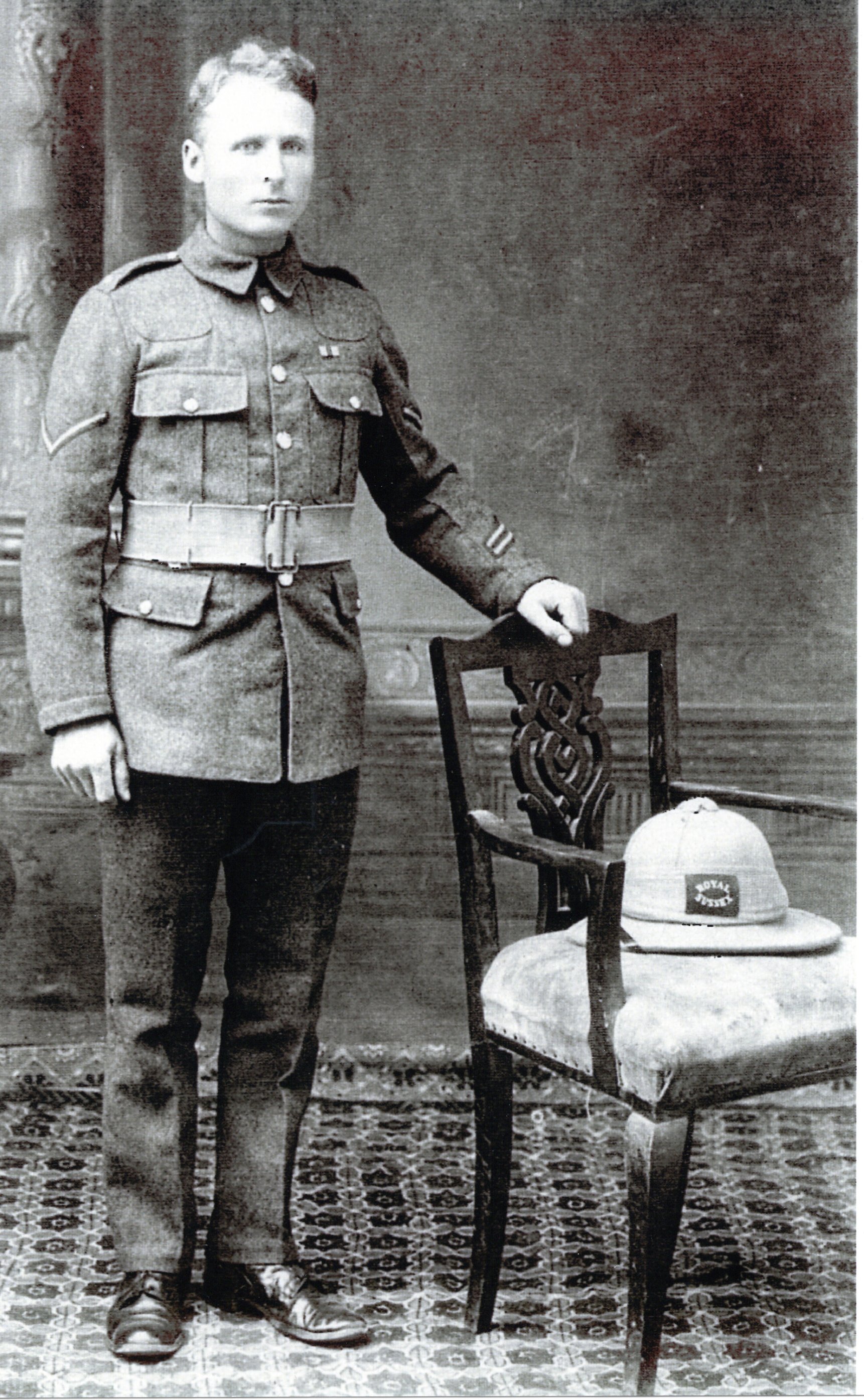
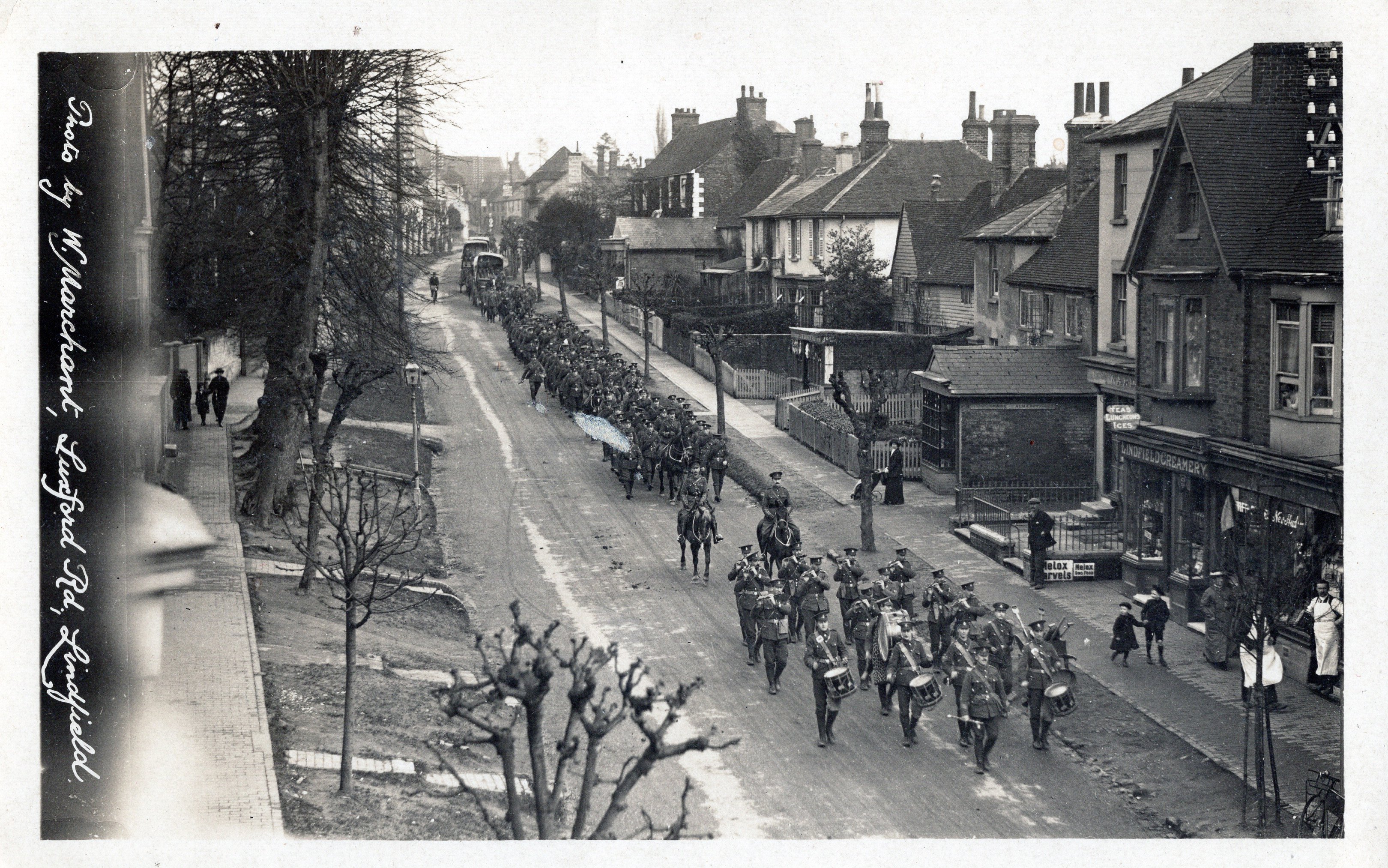
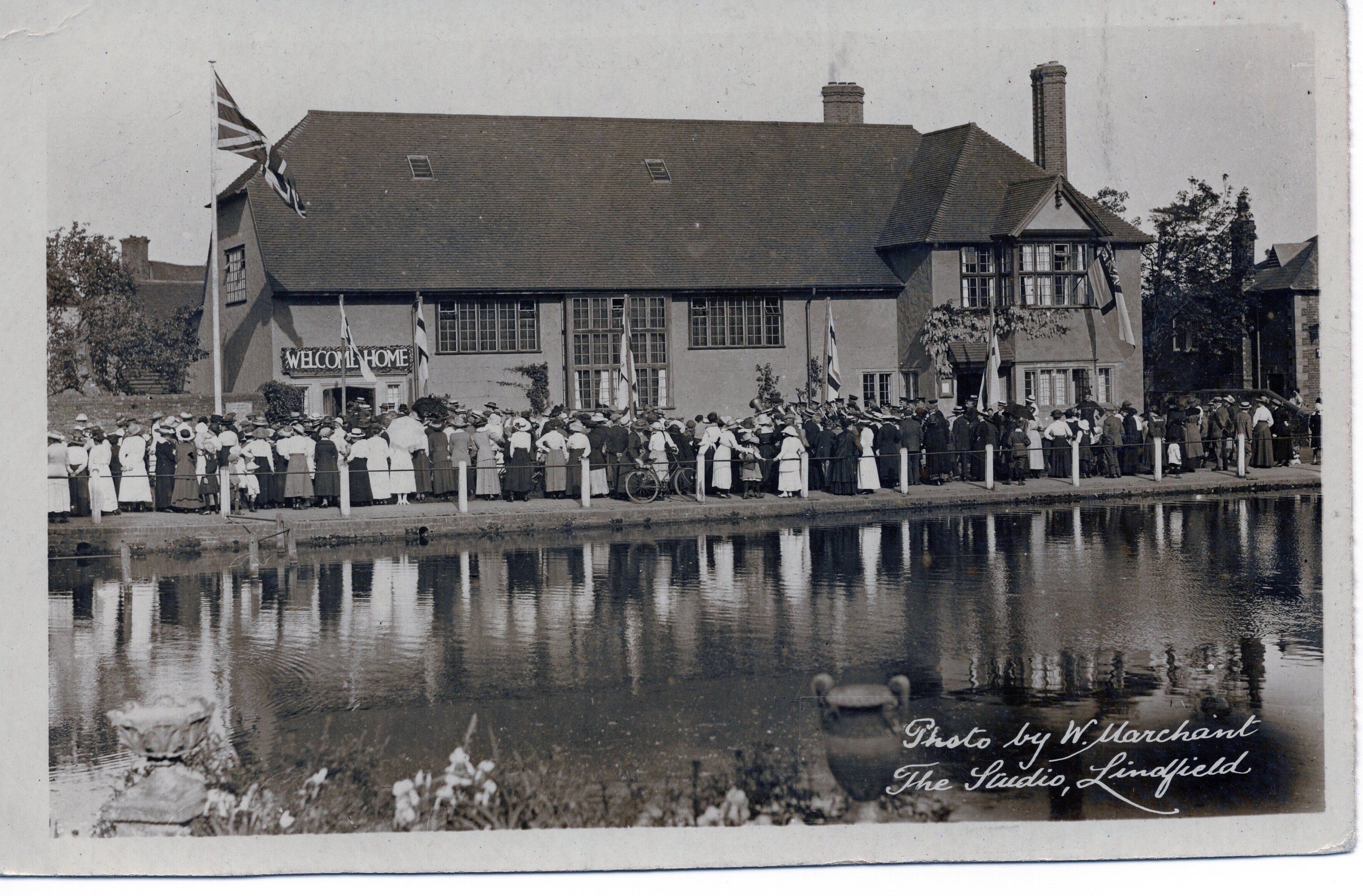
 Lindfield History Project Group